
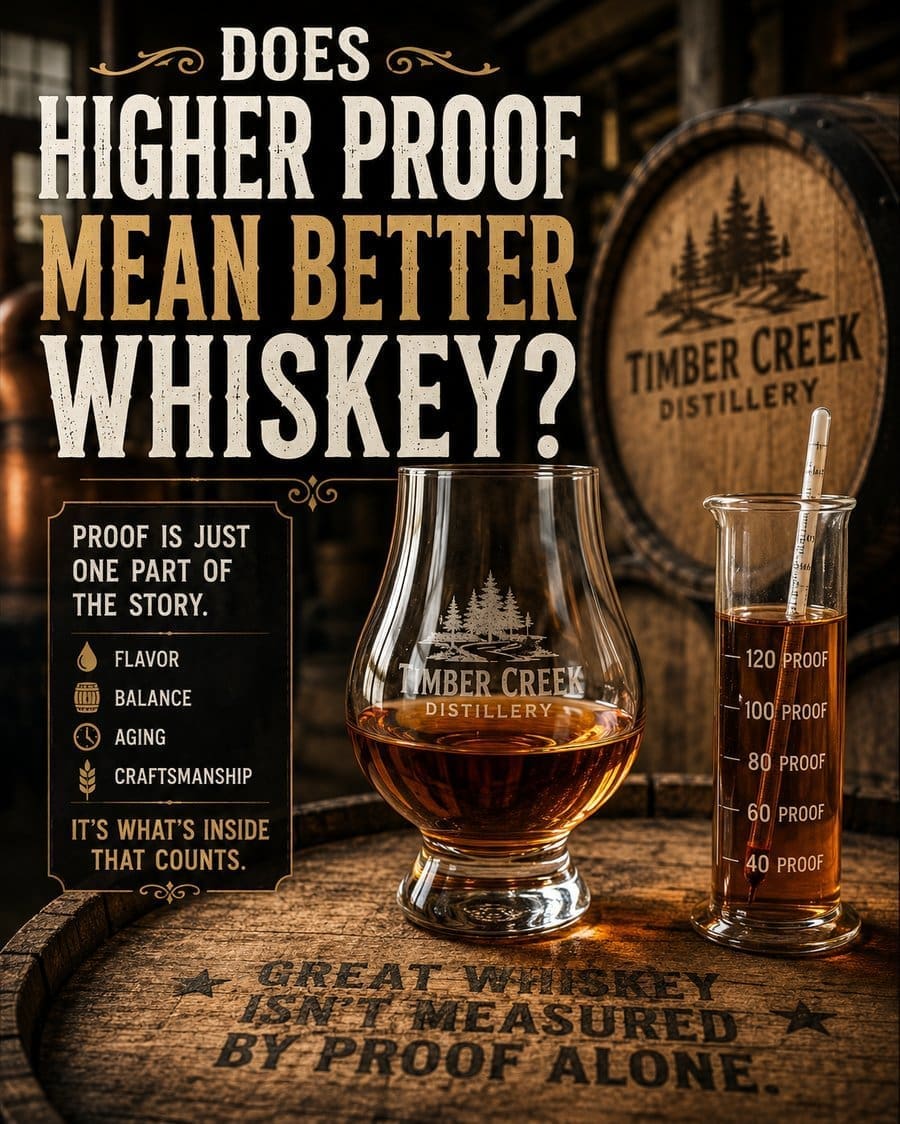
No — higher proof does not mean better whiskey. Proof measures one thing only: how much alcohol is in the bottle. It says nothing about quality, balance, or how good a whiskey will actually taste. A brilliant whiskey can be 80 proof, and a forgettable one can be 130. “Better” is about the spirit and your palate, not the number on the label.
That said, proof is not meaningless. It genuinely changes how a whiskey feels, smells, and tastes, and it shapes how you should drink it. So let’s bust the myth properly: what proof really tells you, what higher proof actually does, and how to find the strength that is best for you.
Quick Facts: Whiskey Proof and Quality
- In the U.S., proof is simply twice the alcohol by volume (ABV). So 80 proof equals 40% ABV.
- The legal minimum for bottling whiskey is 80 proof (40% ABV).
- Higher proof carries more flavor compounds, but also more alcohol “heat.”
- “Higher proof equals better” is a myth — proof measures strength, not quality.
- A few drops of water can “open up” a high-proof whiskey and reveal hidden aromas.
- In hot climates like Florida, a barrel’s proof can actually rise during aging.
What Proof Actually Measures
Start with the basics, because the whole myth rests on a misunderstanding. In the United States, proof is just a number that equals double the alcohol by volume. An 80-proof whiskey is 40% alcohol; a 100-proof whiskey is 50% alcohol. That is all proof tells you.
By law, whiskey must be bottled at a minimum of 80 proof. That floor exists so a spirit cannot be watered down into something thin and characterless. Beyond that minimum, distillers choose a bottling proof for all kinds of reasons — flavor, style, tradition, and price among them.
Crucially, none of those numbers grade the whiskey. Proof is a measurement, not a verdict. Treating it like a quality score is like judging a song by its volume. Louder is not better; it is just louder. For the full vocabulary around strength, our guide to cask strength, barrel proof, and barrel strength breaks down every term you will see on a label.
Where the Word “Proof” Comes From
The term has a colorful backstory. As the old story goes, British sailors and tax officials once tested the strength of rum by soaking gunpowder in it and trying to light it. If the soaked powder still ignited, that was “proof” the spirit was strong enough; if it only fizzled, the rum had been watered down.
That rough test eventually hardened into a formal system. Historically, British “100 degrees proof” worked out to roughly 57% ABV, the point where that gunpowder trick reliably passed. It did the job, but the underlying math was awkward to work with.
The United States later simplified the whole thing. Instead of tying proof to a gunpowder threshold, American regulators defined it as exactly twice the alcohol by volume. That is why an American whiskey’s proof is always just its ABV doubled — clean, simple, and easy to read on any label.
The Myth: Higher Proof Equals Better Whiskey
It is easy to see where the myth comes from. High-proof, barrel-strength bottles are often rare, expensive, and chased by collectors, so the big number gets tangled up with the idea of prestige. Bigger feels bolder, and bolder feels better.
But that logic falls apart fast. Plenty of celebrated whiskeys sit at a modest 80 to 90 proof, and plenty of harsh, unbalanced whiskeys are bottled hot and strong. Strength cannot rescue a poorly made spirit, and it cannot be the reason a great one shines.
Here is the honest version: a higher number gives you more alcohol and, often, more intensity. Whether that intensity is pleasant depends entirely on the whiskey and the drinker. So the real question is never “how high is the proof?” It is “do I enjoy drinking this?” Anything else is just chasing a number.
What Higher Proof Actually Does
Dismissing proof entirely would be just as wrong as worshiping it. Proof does real work in the glass — it simply does not equal quality. Understanding its effects helps you drink smarter.
On the plus side, alcohol is a carrier for flavor. Many of the aromatic compounds created during fermentation, distillation, and aging dissolve in alcohol, so a higher-proof whiskey can deliver more concentrated flavor, a fuller mouthfeel, and a longer finish. That is a big part of why barrel-strength bottles taste so intense.
On the other side sits the burn. Above roughly 100 proof, the sheer heat of the alcohol can overwhelm your palate and actually mask the subtler notes you are trying to taste. In other words, past a certain point more strength can hide flavor rather than reveal it. The compounds responsible for much of that flavor are called congeners, and our piece on congeners in distilling explains where they come from.
How Proof Shows Up in the Glass
You can often sense a whiskey’s strength before you ever taste it. Swirl a pour and watch the “legs,” the oily streaks that run back down the side of the glass. Thicker, slower legs frequently point to a higher-proof, more viscous spirit.
The nose tells you, too. High-proof whiskey can prickle your nostrils if you bury your face in the glass, so nose it gently with your mouth slightly open to let the alcohol vapor escape. On the palate, higher proof usually brings a fuller, weightier mouthfeel and a warmer finish that lingers.
None of these signs measure quality, but they do prepare you for the experience. Knowing a pour is strong lets you slow down, take a smaller first sip, and decide whether a drop of water will help. Reading the glass is half the fun of tasting attentively.
Why Experts Themselves Disagree
If proof and quality were truly linked, the people who make whiskey would all agree on it. They do not, and that tells you plenty.
Some respected producers bottle high and stand firmly behind it. Their argument is simple: whiskey carries flavor, water does not, so the less a distiller dilutes before bottling, the more flavor survives in the glass. To them, a robust proof is a sign of a spirit delivered closer to how it left the barrel.
Other equally respected makers push back. They argue that very high proofs — well past 100, and certainly past 120 — can blur the delicate subtleties that separate a fine whiskey from a merely powerful one. For them, balance and finesse matter more than raw strength. Both camps make good whiskey, which is the whole point: there is no single “correct” proof, only different philosophies.
More Proof Myths, Busted
The “higher is better” myth has a few stubborn cousins, and clearing them up makes you a sharper whiskey shopper.
Myth: Darker whiskey is stronger or older. Color comes mostly from the barrel and char. Since added coloring is not allowed in bourbon, a dark pour can simply mean an active barrel rather than higher proof or extra age.
Myth: Higher proof means more calories per serving. Alcohol does carry calories, but sugars and other ingredients matter too, and serving sizes vary. Proof alone is an unreliable calorie gauge.
Myth: Cask strength is always the best version. Cask strength is wonderful when you want intensity and control over your own dilution, but it is a style, not a grade. Plenty of drinkers prefer the balance of a thoughtfully proofed-down bottle.
Myth: High proof always means harsh. A well-made, well-aged high-proof whiskey can be remarkably smooth. Harshness usually points to youth or rough distillation, not strength by itself.
Whiskey Proof Levels at a Glance
Different proof ranges suit different moments and drinkers. None is inherently superior, but each behaves a little differently. Use this as a rough guide rather than a rulebook.
| Proof | ABV | What to Expect |
|---|---|---|
| 80 proof | 40% | The legal minimum. Smooth and approachable; great for newcomers, easy sipping, and cocktails |
| 90 proof | 45% | A balanced middle ground with more body, still very drinkable neat |
| 100 proof | 50% | The Bottled-in-Bond standard. Bold and flavorful, a classic sipping strength |
| 100–130+ proof | 50–65%+ | Barrel or cask strength. Intense and concentrated; often best with a few drops of water |
Notice that 100 proof carries special weight. It is the strength required for the historic Bottled-in-Bond designation, an early American quality guarantee — and a reminder that the number 100 is about authenticity rules, not a quality ranking. Our guide to what bottled-in-bond means tells that story.
The Water Trick: Proofing Down in the Glass
Here is the move that settles the whole debate in your own glass. If a whiskey feels too hot, you do not have to drink it that way. Add a few drops of water, swirl, and taste again.
This technique, called “proofing down,” does something almost magical. Lowering the strength just a touch tames the alcohol burn and lets subtle aromas — vanilla, fruit, spice, oak — step out from behind the heat. You are not weakening the whiskey; you are opening it up. Even devoted fans of high-proof bottles reach for the water dropper.
The method is simple. Start with a small neat sip to taste the whiskey as the distiller bottled it, then add one drop of room-temperature water at a time, tasting after each. Stop when it tastes best to you. That personal sweet spot is the real answer to “what proof is best,” and it changes from bottle to bottle. A guided tasting experience is a great way to practice the technique with someone walking you through it.
Proof in Cocktails and on the Rocks
Strength matters more than usual once you start mixing. Ice melts and mixers dilute, so a lower-proof whiskey can fade into the background of a cocktail. A higher-proof pour holds its own, keeping the whiskey’s character front and center even over ice.
This is exactly why bartenders often reach for 100-proof or bottled-in-bond bottles in classic drinks. The extra strength survives dilution and stands up to sweet or citrusy ingredients instead of getting lost. A little simple syrup in the mix only makes that balance more important.
So your proof choice is partly about how you plan to drink. Sipping slowly by the fire favors one approach; building an Old Fashioned favors another. Neither is “better” — they simply serve different glasses.
Proof, the Barrel, and the Florida Effect
Proof is not fixed once a whiskey is made; it shifts throughout production. The proof a spirit goes into the barrel at — the barrel entry proof — helps shape its final flavor. A lower entry proof tends to pull more sweet, water-soluble compounds from the oak, while a higher one tends to draw out spicier tannins.
Then the climate takes over. Inside the barrel, whiskey constantly loses liquid to evaporation, the famous “angel’s share.” In hot, humid places, something counterintuitive happens: water molecules are smaller than alcohol molecules and escape through the wood more easily, so more water evaporates than alcohol. As a result, the proof inside the barrel can actually climb as the whiskey ages.
That is a real factor here in Florida, where the heat works the barrels hard. It is one of the reasons whiskey ages faster in Florida and why Florida whiskey develops differently from its Kentucky cousins. The deeper mechanics of all this live in our explainer on barrel aging.
So What Proof Should You Drink?
The honest answer is the one that frustrates number-chasers: whichever proof you enjoy most. There is no trophy for drinking something stronger, and no shame in loving an 80-proof pour.
If you are newer to whiskey, starting in the 80-to-94 proof range is smart. Those whiskeys let you pick out flavors without an overwhelming blast of heat. As your palate adjusts, you can climb toward higher-proof and barrel-strength bottles and decide whether you actually prefer them.
A fun way to learn is a “proof flight” — tasting the same style at different strengths side by side. It quickly reveals that your favorite is rarely just the strongest one. The grain recipe matters too, which is why our mash bill guide and our breakdown of single barrel vs. small batch are worth a read once you start comparing bottles seriously.
Reading a Whiskey Label Beyond Proof
If proof is not a quality score, what should you actually look for? A few label details tell you far more about what is in the bottle than the strength does.
Age statements, mash bill information, and single-barrel or small-batch designations all give concrete clues about character. A distillery that openly makes and ages its own spirit, rather than buying it from elsewhere, is another strong signal of what you are getting.
Meanwhile, stay skeptical of vague marketing words. Terms like “craft,” “fine,” “premium,” and “smooth” have no legal definition and tell you almost nothing on their own. Stick to the concrete facts on the label, and let your own palate be the final judge of quality.
How Timber Creek Thinks About Proof
At our distillery in Crestview, proof is a tool, not a bragging right. We barrel our new spirit at about 110 proof and let Florida’s climate do its work over five to seven years, knowing the heat will shape both the flavor and the strength inside the wood.
When it comes time to bottle, we choose the proof that shows each spirit at its best rather than reaching for the biggest possible number. Sometimes that means a touch of water to bring a whiskey into balance; sometimes it means leaving it bold. The goal is always flavor, not a number to brag about.
Our single-grain method gives us extra control here. Because we distill and age each grain separately before blending, we can fine-tune the final character — including how strength and flavor play together. You can see that philosophy across our grain-to-glass process and our full lineup of Florida-made spirits.
It is also the idea behind our Bourbon Blending Experience, where you taste individual components and balance them yourself. Spend an hour blending, and the higher-proof myth dissolves on its own — you quickly learn that the best pour is the one that tastes right, not the one with the biggest number.
Taste the Difference for Yourself
The best way to retire the higher-proof myth for good is to taste across the range and trust your own palate. Our tastings and experiences let you compare spirits side by side, learn the water trick from someone who does it daily, and even blend your own bottle at the Bourbon Blending Experience.
Hosting a group? Our private events make for a memorable, hands-on outing, and you can always pick up your favorites in the shop. Whatever proof wins you over, the right answer is simply the one you reach for again.
Keep Exploring Timber Creek
If this cleared up the proof question, there is more myth-busting where it came from. Start with the fundamentals in what whiskey is and what bourbon is, then sort out the most common mix-up with our guide to whiskey vs. bourbon. Curious how the spirit is built from the ground up? See the careful cut between heads, hearts, and tails and learn the craft on our working distillery page. When you are ready to taste it all in person, here is what to expect on your first visit. The number on the label is only the beginning of the story.


