

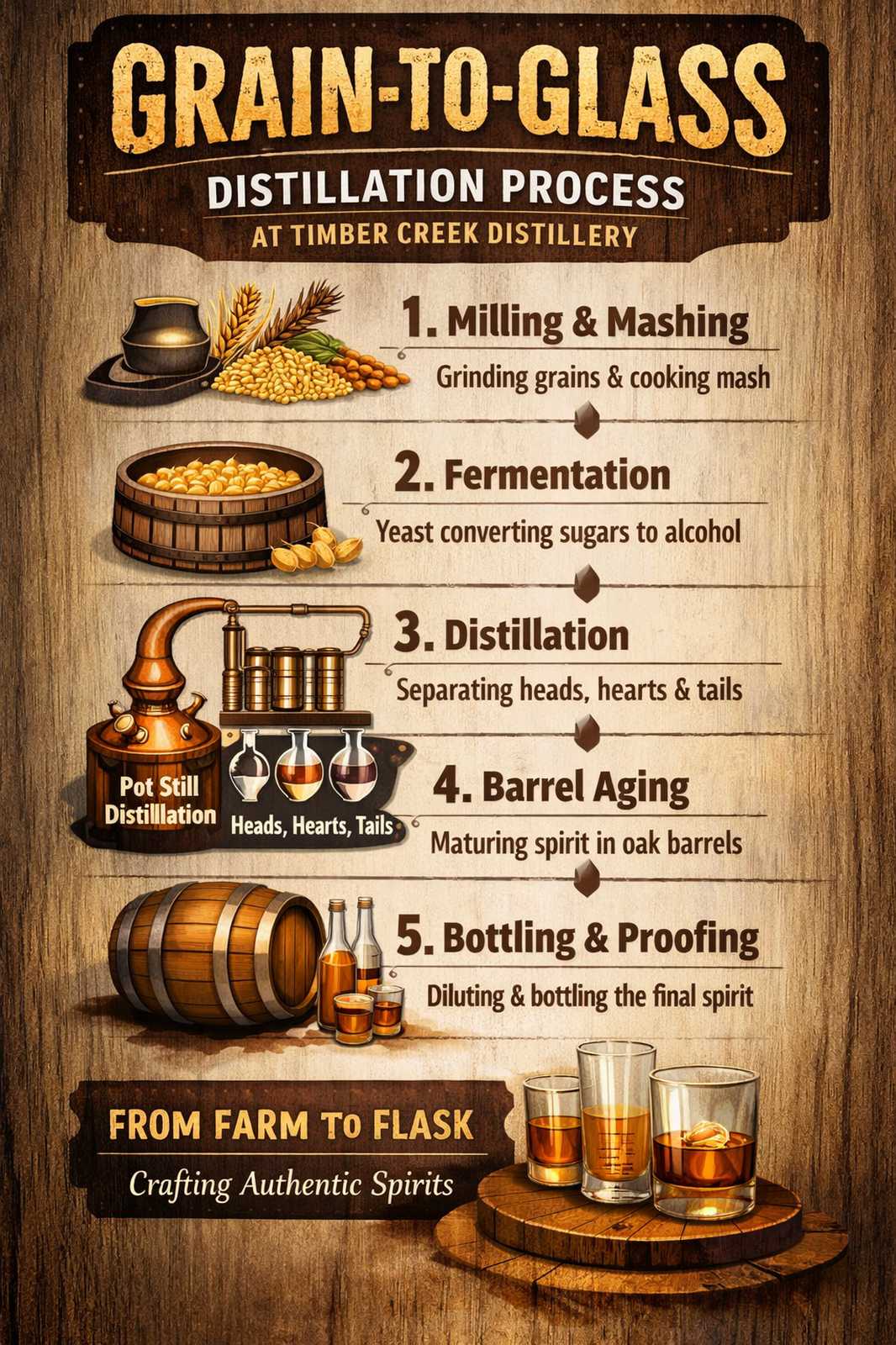
Grain-to-Glass Distillation at Timber Creek Distillery: Inputs, Process Control, and Why the Hard Way Wins

This is a technical post describing how Timber Creek Distillery converts agricultural inputs into finished spirits by controlling the full chain: raw material intake, milling, mash conversion, liquid–solid separation, fermentation management, and pot-still distillation with cut strategy driven by temperature staging and sensory confirmation.

The thesis is simple: the distillate is the sum of the inputs and the control surfaces. The inputs are grain (corn, wheat, barley, rye) and evaporated cane syrup (a precursor molasses). The control surfaces are mechanical (silos, augers, milling geometry), biochemical (enzyme selection and temperature staging), microbiological (yeast and fermentation conditions), and thermodynamic (vapor path design, condenser geometry, staged energy input, and cut discipline).


Raw Material Intake and Sourcing Strategy

Primary Inputs: Grain Set + Cane Syrup

Timber Creek Distillery runs a dual input philosophy:

Corn

Corn

  • Whiskey inputs: corn, wheat, barley, and rye.
  • Rum-family input: evaporated cane syrup used as a precursor feedstock (a controlled path toward a molasses-like fermentable base without relying on inconsistent bulk molasses streams).

Sourcing Economics: Distance Is a Real Ingredient

Grain sourcing is partially a flavor decision, but it is also an engineering cost decision. When the unit of purchase is a truckload (50,000+ pounds), diesel becomes a line item that directly competes with quality investments elsewhere (equipment, utilities, labor, downtime tolerance). The operational bias is to source as close as feasible because transport is not free—in either money or risk.

Heirloom Rye and Terroir Visibility in Distillate

Timber Creek uses an heirloom rye described as Florida 401 Black Rye as a deliberate exception to purely economic selection. The reason: rye is one of the few grains where origin and agronomic stress can remain legible in the final distillate when the process is built to preserve congeners and flavor oils. In practical terms, rye can carry distinctiveness through pot-still production in a way that certain heirloom corn experiments often do not.

There is an observed “wine rule” that applies here: the crop that struggles can be the crop with the story. A rye yielding ~8–10 bushels per acre is agronomically brutal compared to high-yield corn, but it can be sensorially generous. Corn, by contrast, is a carbohydrate powerhouse (200 bushels/acre is not exotic in good conditions). It is a superb ethanol substrate and a foundational bourbon grain, but it is often less intrinsically expressive. This is a partial explanation for why corn dominates bourbon mash bills: it is efficient, available, and structurally useful, even when it is not the loudest narrator.


Bulk Grain Handling, Silos, and Moisture Reality

Why Whole Grain Storage Instead of Pre-Milled Inputs

Timber Creek stores grain whole and mills on-site for three reasons:

  1. Freshness control: milled grain behaves like flour—high surface area, rapid oxygen exposure, aggressive moisture uptake, accelerated staling.
  2. Process ownership: milling is a critical control step; skipping it externalizes one of the most consequential variables in conversion and separation.
  3. Scale alignment: bulk purchasing and silo storage match the throughput reality of a working distillery.

Why Silos (And Why Florida Makes Them Annoying)

Metal silos are a tried-and-true storage form because they keep precipitation out, elevate grain off the ground, and significantly reduce rodent intrusion. They also integrate cleanly with auger-based conveyance systems for truck-to-silo and silo-to-process transfer.

Florida adds a constraint: humidity. Grain can tack to silo walls and bridge. Augers—simple screw conveyors driven by electric motors—are mechanically straightforward but operationally sensitive to gum-up and start torque issues in high moisture conditions. The real-world workaround is unglamorous: clearing, de-bridging, occasional percussive persuasion, and learning the difference between “won’t start” and “won’t run.”

Truckload Economics and the Cost of Packaging

Buying in full loads is not a flex; it is a math problem. One truck hauling near legal road capacity spreads the fuel cost across maximum payload. Farmers also price bulk more favorably when they are not required to bag, palletize, and handle smaller units. Timber Creek’s infrastructure—truck unloading, augers, silos, and indoor holding hopper staging—exists to turn bulk economics into operational stability.


Grain Processing and Size Reduction: Roller Milling as a Separation Strategy

Roller Mill vs Hammer Mill: Yield Maximization vs Separation Discipline

In much of U.S. distilling, hammer milling is common: grain is reduced to fine particulate (often approaching flour), increasing surface area and improving extract efficiency. That approach is aligned with a fermentation-on-grain / distillation-on-grain workflow where separation is deferred.

Timber Creek intentionally runs a double roller mill (two 10 HP three-phase motors) because the goal is not purely maximum extract; it is controlled liquid–solid separation via lautering. Roller milling cracks and opens the endosperm while limiting excessive flour formation. The downstream benefit is a workable grain bed and reduced carryover of woody husk components.

Why Husk Management Matters: Tannins and “Cleanliness” of the Mash Stream

Removing husk material prior to fermentation is an upstream decision that changes downstream flavor. The husk contributes tannic compounds and astringent structure that may not remain fully trapped in the stillage. If the distillation philosophy is “preserve oils,” then the filtration philosophy must be “avoid dragging husk-derived bitterness into the system.”

Particle Size Distribution: Viscosity, Enzyme Access, and Pumpability

Particle size drives two competing constraints:

  • Conversion support: smaller particles expose more starch and improve enzyme access.
  • Separation penalty: smaller particles increase viscosity and can collapse filtration behavior (stuck beds, smeared runoff, slow flow).

Timber Creek accepts reduced maximum yield potential in exchange for a process that remains separable, pumpable, and more sensorially precise. This is a strategic trade: the distillery cannot compete on industrial volume, so it competes on control and repeatable quality character.

Recirculated Mash-In: Temperature Uniformity and Anti–Hot Spot Behavior

During mash-in, Timber Creek recirculates from the bottom of the mash tun back to the top while agitation is running. This is a practical solution to two real problems:

  • Distribution: grain is introduced while the system is moving, limiting clumping and stratification.
  • Thermal homogeneity: recirculation reduces localized overheating even in steam-jacketed systems, making conversion behavior more predictable.

Mechanical Reality: Everything Breaks (So the Design Assumes It)

Any distillery operating at real throughput becomes a maintenance business with a spirits side hustle. Augers bind. Bearings wear. Seals fail. Motors cook. Pumps cavitate. The operational response at Timber Creek is not romantic: assume failure, overbuild where sensible, keep parts on hand, and keep the process simple enough to repair without a committee.


Mash Conversion and Enzymatic Hydrolysis: Temperature Staging as Process Ownership

Single-Grain Mashing and Distillation as an Optimization Framework

Timber Creek runs a single-grain workflow to avoid compromise conditions. Different grains gelatinize differently; they also behave differently under shear, heat, and enzyme action. Co-mashing is inherently a negotiation—one set of parameters must serve multiple substrates. Single-grain production allows the distillery to tune conversion and fermentation around the grain rather than forcing a single “average” process across all grains.

Gelatinization, Then Enzyme Windows

The conversion philosophy is staged:

  1. High-temperature phase: drive gelatinization for the target grain.
  2. Controlled cooling: drop temperature (often via cold water addition) into enzyme-appropriate windows.
  3. Enzyme sequencing: deploy enzymes in a way that privileges conversion without turning the mash into immobile concrete.

Alpha Amylase, Beta Amylase, and Viscosity Reduction (“Flow Enzyme”)

Timber Creek uses:

  • Alpha-amylase: applied after gelatinization once the mash temperature is within a workable range (commonly around the mid-70°C band depending on product and vendor spec).
  • Beta-amylase: applied at a lower band (commonly around the mid-60°C band) to increase fermentable sugars relative to dextrin formation.
  • Beta-glucanase for flow/viscosity: a viscosity-reduction enzyme used to address gummy mashes, especially relevant to wheat, barley, and rye beta-glucans (for reference, a commercial example category is SEBflo TL-style beta-glucanase products).

External technical references used in this domain (for readers who want to go deeper):
viscosity reduction enzymes in craft distilling,
beta-glucanase context for thick mashes,
enzyme usage discussion (HomeDistiller).

Mash Thickness, Heat Transfer, and Conversion Completeness

Thick mashes are conversion-hostile for mundane reasons: heat transfer, mixing, and enzyme diffusion are all worse. A wetter mash improves circulation and stabilizes conversion kinetics. Time is not optional here; thermodynamics does not negotiate. The system is tuned toward practical convertibility rather than theoretical maximum sugar extraction.


Wort Separation Evolution: From Lauter Tun to Vibratory Screening

Phase 1: Traditional Lauter Tun (Functional, Then Unforgiving)

Timber Creek started with a conventional lauter tun because it was accessible as off-the-shelf brewery hardware (mash tun, lauter tun, hot liquor tank, brew kettle). That initial system worked, but it also created a recurring operational pain: sticky beds, clogs, and too many moments where the solution involved crawling into a vessel that should not require human entry as a normal operating procedure.

The lauter tun failure mode was predictable: slight over-gelatinization (especially with corn) increased viscosity, reduced permeability, and triggered stuck runoff. Recovery tactics included rakes, reverse flow, and “water hammer” style clearing attempts to rebuild a functional bed.

Phase 2: Vibrascreen Separation (Continuous Process Bias)

Timber Creek transitioned to a vibrascreen because it converts separation into a more continuous workflow: mash is pumped in, liquids and solids split, the liquid stream proceeds to cooling and fermentation, and solids are directed to the dump trailer for agricultural reuse.

This change prioritizes process continuity and labor efficiency over absolute recovery efficiency. Some moisture (and therefore some dissolved sugars) exits with solids. That is an accepted loss in exchange for reliable operation and stable fermentation feedstock quality.

Additional “practitioner” reading on separation hardware and filtration concepts:
filtration and screens discussion (HomeDistiller).


Byproduct Utilization: Stillage, Spent Grain, and Farm-Scale Circularity

Spent Grain as Feed and Soil Benefit

spent corn

Solids are routed to local farmers for pigs and cattle. Beyond feed value, the post-feed deposition zones reportedly green aggressively—an indicator that the spent material remains rich in nutrients and organic matter. This matters because sustainability is not a slogan in a farm context; it is operational self-interest.


Wort Cooling and Fermentation: Closed, Stainless, Controlled

Counterflow Cooling as Yeast Protection

Liquids pass through a counterflow cooling system (implemented via stainless tote and exchanger workflow) to drop temperature into a yeast-ready band before fermentation. Rapid knockdown reduces microbial risk and improves yeast viability.

Closed Fermentation and Temperature Control

Fermentation is conducted closed and temperature-controlled (jacketed fermenters). This is a risk posture: open fermentation can be artistically valid, but it is also a deliberate exposure to ambient microbial ecosystems. Timber Creek does not run that gamble as a default mode.

Two-Yeast Strategy: Ester Profile vs Workhorse Cleanliness

The yeast stack includes:

  • SafAle “05” style strain: familiar, ester-capable, historically reliable across beer and distilling-adjacent fermentation.
  • A second “workhorse” strain: introduced via professional brewing network; ferments hot and fast while remaining comparatively clean.

Fermentation duration is generally targeted in the 3–5 day band depending on substrate, temperature, and yeast behavior.

Fermentation Temperature and Congener Management

Higher fermentation temperatures increase the risk of producing higher alcohols and volatile congeners associated with harshness and undesirable aftereffects. Cooler, controlled fermentation is used to keep the spirit base aligned with the distillery’s “clean but not sterile” target: enough character to matter, without the penalties of stressed fermentation chemistry.


Distillation Architecture: Pot Still Bias, Column Still Utility

Why Pot Still (Even When It Costs Time)

Timber Creek operates both a pot still and a column still but defaults to pot still operation because the goal is not maximal throughput; it is the preservation of desirable oils and grain identity. Column distillation can be useful when neutrality is the objective, but this system is configured to retain flavor by design.

In cases where a column is used, it is not treated as “the finish.” The column is configured for moderate proof uplift (roughly the mid-30% range), with finishing still performed in pot mode for final control and character.

Bell-Shaped Pot Head and Worm Condenser: Reflux, Copper, and Texture

The pot still uses a bell-shaped head feeding into a Scottish-style shell-and-worm condenser arrangement. The practical consequences:

  • Reflux behavior: long vapor path and cooling gradient encourage reflux, increasing separation while still retaining pot-still texture.
  • Copper contact in vapor phase: copper interaction occurs primarily with vapor, supporting sulfur compound reduction in the vapor path.

Technical reading on copper’s role in vapor-path sulfur management (industry-adjacent discussion):
copper presence and sulfur/meaty aroma control (StillDragon discussion referencing published findings).


Stripping Run: ABV Uplift Without Early Cuts

Purpose: Concentration and Workflow Efficiency

The stripping run is executed to convert a relatively low ABV wash (≈7% ethanol) into low wines in a higher band (≈35% ethanol). Cuts are not prioritized here because the spirit run is the stage where cut discipline is applied. The objective is to simplify workflow: collect, concentrate, then refine.

Why Not Cut on the Strip

It is not that early cuts are impossible on a strip; it is that they are inefficient in labor and attention. Timber Creek reserves precision for the stage that matters most: the spirit run, where the cut window is narrower and the outcome directly defines the barrel entry character.


Spirit Run and Fractionation: Staged Temperature Control + Sensory Confirmation

PID-Based Thermal Control as a Fractionation Tool

The spirit run is managed using a PID temperature measurement strategy at the top of the pot still, controlling steam input via a valve system. There is unavoidable thermal lag between steam input and bulk-liquid response, so the run is brought up in controlled stages rather than slammed into target ranges. This is a deliberate attempt to keep the system inside a narrow controllable band while dealing with hundreds of gallons of thermal mass.

Heads Management: Targeting Volatile Early Fractions

Early fractions are managed aggressively to remove volatile components associated with harshness and undesirable sensory outcomes. The run is staged below ethanol’s primary boiling point band to encourage early volatiles to present first, then transitioned upward as the operator verifies the progression through sensory signals.

Timber Creek’s operator description of the transitional phase includes an undesirable cardboard-like note as the system moves through early fractions into a more acceptable band.

Hearts Collection: Where the Barrel Starts

After early fractions are cleared by staged control and sensory confirmation, the system is adjusted to collect the ethanol-forward hearts fraction. This is the distillate intended for barreling and final product pathways.

Barrel Entry Proof Targeting: Character Over Neutrality

Timber Creek targets a barrel entry band around ~110 proof for its whiskey pathway, intentionally allowing additional oils and congeners to remain present. This is a conscious trade: slightly lower “cleanliness” in exchange for higher texture and grain-derived identity that remains legible after maturation.


Why This Method Exists: Control Surfaces, Not Marketing Surfaces

Small Team Reality: Tools Must Replace Headcount

This system is operated by a very small team, often a single operator running the equipment. Process design must therefore be operable by one person without sacrificing safety or repeatability. The philosophy is not “slow for romance.” It is “controlled because the system must be run correctly with limited hands.”

Quality vs Quantity: A Structural Constraint, Not a Slogan

Industrial producers can win on scale. Timber Creek cannot, and does not try. Instead, it wins on control and the willingness to discard outcomes that do not meet standard. Large producers can be excellent (MGP is a common example of high-quality sourced whiskey), but the operational incentives are different when hundreds of employees and massive production commitments exist. A small distillery can dump a batch because the process feels wrong; a large operation cannot always afford that kind of stubbornness.

Private Label and Custom Spirits: Single-Grain Inventory as Strategic Leverage

The single-grain methodology creates a private label advantage: the distillery can blend with intention, creating a whiskey or bourbon profile that is proprietary to a client because it is assembled from controlled component spirits rather than a single monolithic mash.

This is where technical method becomes commercial leverage:
private label spirits is not “put your logo on a bottle.” It is build a spirit that is structurally yours.


Why Timber Creek Uses a Roller Mill Instead of a Hammer Mill

Timber Creek uses a roller mill to preserve a separable grain structure for lautering and upstream husk removal. Hammer mills maximize extraction by reducing grain to flour, but they also increase viscosity and particulate carryover. Timber Creek trades some yield for cleaner separation and reduced tannin contribution from husk material.

What “Single-Grain Distillation” Means at Timber Creek

Single-grain distillation means each grain (corn, wheat, rye, barley) is mashed, fermented, and distilled as its own optimized process rather than co-mashed under compromise conditions. The benefit is tighter control of gelatinization windows, enzyme staging, fermentation behavior, and final blending capability.

Why Timber Creek Uses a Vibrascreen Instead of a Lauter Tun

Timber Creek transitioned from a traditional lauter tun to a vibrascreen because the vibrascreen enables continuous liquid–solid separation with less vessel-entry labor and fewer stuck-bed failure modes. The tradeoff is modest recovery loss because solids exit with moisture and residual sugars.

Why a Pot Still and Worm Condenser Are Used for Flavor Retention

Pot still operation with a long vapor path and worm-style condenser supports reflux behavior and copper vapor-phase interaction, preserving texture and desirable oils while reducing sulfur compounds. This is slower than high-proof column distillation but better aligned with flavor-forward whiskey goals.


If You Want This Level of Control for Your Brand

Timber Creek Distillery’s production model is built for clients who want a spirit that is technically defensible, sensorially distinct, and not interchangeable with sourced inventory. If the goal is a proprietary bourbon or whiskey profile that can’t be replicated by another label buying the same bulk barrels, start here private label spirits inquiry.