


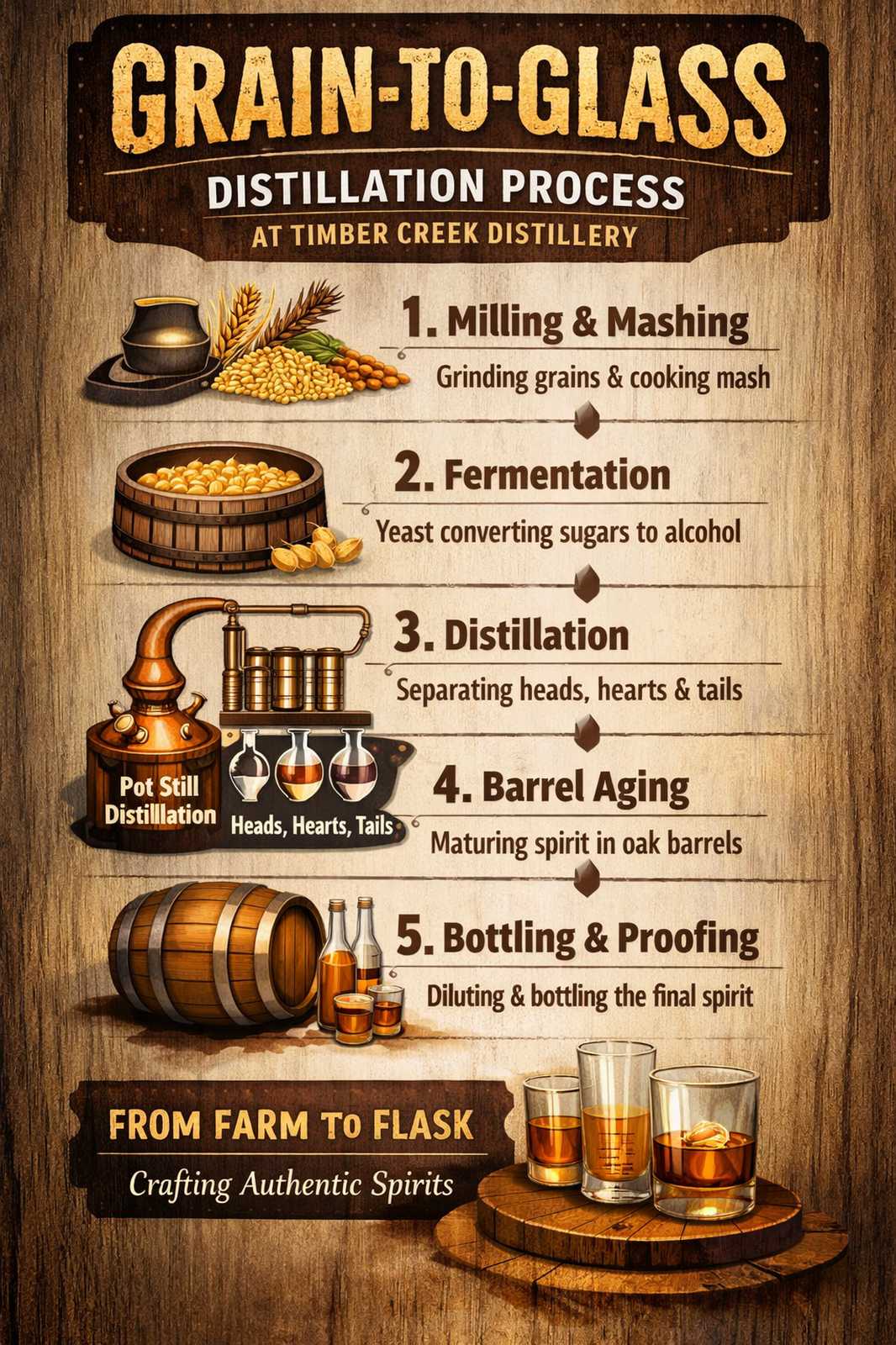
Grain-to-Glass Distillation at Timber Creek Distillery: Inputs, Process Control, and Why the Hard Way Wins
This technical post explains how Timber Creek Distillery converts agricultural inputs into finished spirits by controlling the entire production chain — from raw material intake and milling to mash conversion, liquid–solid separation, fermentation management, and pot-still distillation with disciplined fraction cuts. If you are new to the mechanics of the still itself, begin with our breakdown of how distillation works, then return here for the applied version.
The thesis is simple: the distillate is the sum of the inputs and the control surfaces. The inputs are grain (corn, wheat, barley, rye) and evaporated cane syrup. The control surfaces are mechanical (silos, augers, milling geometry), biochemical (enzyme selection and temperature staging), microbiological (yeast and fermentation conditions), and thermodynamic (vapor path design, condenser geometry, staged energy input, and cut discipline). Those cuts — the separation of volatile fractions into heads, hearts, and tails — are explained in detail in our technical guide to heads, hearts, and tails.
Raw Material Intake and Sourcing Strategy
Primary Inputs: Grain Set + Cane Syrup
Timber Creek Distillery runs a dual input philosophy:
- Whiskey inputs: corn, wheat, barley, and rye — the structural grains discussed in our Mash Bill Guide.
- Rum-family input: evaporated cane syrup used as a precursor feedstock for fermentation, forming the base for our rum pathway.
Heirloom Rye and Terroir Visibility in Distillate
Timber Creek uses heirloom Florida 401 Black Rye as a deliberate exception to purely economic grain selection. Rye is one of the few grains whose agronomic stress and origin can remain legible in a pot-still system built to preserve congeners and grain oils. For a deeper look at how those flavor compounds behave during fermentation and distillation, see our analysis of congeners in distilling.
Grain Processing and Size Reduction: Roller Milling as a Separation Strategy
Roller Mill vs Hammer Mill
Many distilleries use hammer mills to reduce grain to near-flour. Timber Creek instead runs a double roller mill because the objective is not just extraction efficiency — it is controlled separation and lautering discipline. This milling choice supports our broader single-grain philosophy described in Separate Grain Distillation.
Why Husk Management Matters
Upstream husk removal affects downstream flavor. If the distillation goal is to preserve oils in a pot still rather than strip toward neutrality in a column, then upstream tannin control matters. For a technical comparison of still types and how they influence flavor retention, see Pot Still vs. Column Still.
Mash Conversion and Enzymatic Hydrolysis
Single-Grain Optimization
Co-mashing forces compromise. Timber Creek instead mashes, ferments, and distills each grain individually. This allows gelatinization, enzyme staging, and fermentation conditions to be optimized for each substrate rather than averaged across them. The structural impact of those grain choices is explored further in our complete mash bill breakdown.
Enzyme Staging and Flow Control
Alpha-amylase and beta-amylase are applied in temperature-controlled windows after gelatinization. Viscosity-reduction enzymes are used when needed to keep mash flow stable and separable. These biochemical decisions influence fermentation performance, which is covered in depth in our guide to fermentation for distilling.
Wort Separation: From Lauter Tun to Vibrascreen
Timber Creek transitioned from a traditional lauter tun to vibratory screening because continuous separation improves workflow stability. While some recovery efficiency is sacrificed, process continuity and fermentation consistency improve.
Wort Cooling and Fermentation
Closed, Temperature-Controlled Fermentation
After separation, liquid is rapidly cooled through a counterflow exchanger to protect yeast viability. Fermentation occurs in closed, jacketed stainless vessels to control temperature and congener formation. Warmer fermentations can increase higher alcohol production; controlled temperatures align the base spirit with the distillery’s “clean but not sterile” objective.
If you want the technical chemistry of how fermentation temperature influences higher alcohol formation, refer to our full discussion of congener formation in distilling.
Distillation Architecture: Pot Still Bias
Timber Creek operates both pot and column stills but defaults to pot operation for flavor retention. Column distillation is useful when neutrality is required, but flavor-forward whiskey benefits from pot still reflux behavior and copper vapor interaction. For a structural comparison of these systems, see our technical still comparison.
Stripping Run
The stripping run concentrates wash into low wines without precision cuts. Cuts are reserved for the spirit run.
Spirit Run and Fractionation
The spirit run is managed with staged temperature control and sensory confirmation. Early fractions are removed aggressively before transitioning into hearts collection. For a step-by-step explanation of cut strategy, see how heads, hearts, and tails are managed.
Barrel Entry and Aging
Whiskey is typically entered into barrel around ~110 proof to preserve oil structure and grain identity. Lower entry proof allows more congeners to remain present for maturation. For a deeper look at how oak transforms spirit over time, read Barrel Aging Explained.
Single-Grain Inventory as Commercial Leverage
The single-grain methodology enables proprietary blending for clients. Instead of sourcing anonymous bulk barrels, Timber Creek blends from controlled component spirits. If you are exploring a custom bourbon or whiskey program, begin with our overview of private label spirits.
If You Want This Level of Control for Your Brand
Timber Creek Distillery’s grain-to-glass production model exists for brands that want defensible process control and distinct sensory outcomes. To start a proprietary program, submit a private label spirits inquiry.