



One of the biggest gaps between craft distilleries and the general public isn’t interest — it’s language.
The words used to describe how spirits are made and how they taste often sound technical, abstract, or overly poetic. This guide breaks down the core vocabulary used inside a working distillery and at the tasting glass, using real-world terminology that actually applies to production and drinking.
Basic Distillery Equipment
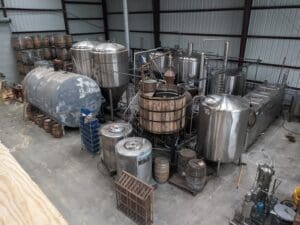
overview of the distillery
At its core, a distillery is a controlled system for converting grain into alcohol, then refining that alcohol through heat, copper contact, and time. The process begins with cooking and fermentation and moves into distillation, collection, and aging. Understanding the equipment helps demystify why different spirits — even within the same category — can taste radically different.
A mash tun is where milled grain is mixed with hot water to convert starches into fermentable sugars. From there, the liquid is transferred into a fermenter, where yeast turns sugar into alcohol while generating heat and a wide range of aromatic compounds. Those fermentation aromas are not incidental — they are foundational to the final spirit’s character.
Distillation
Distillation takes place in either a pot still, a column still, or a combination of both.  Pot stills operate in batches and tend to preserve heavier oils and flavor compounds, while column stills allow for faster processing and greater efficiency. We can do a 660 gallon of mash in a pot per day or about 6000 gallons of mash through the column for the stripping run. We reach about 35% alcohol through the first run. The column carries less flavor through the distilling process. After vapor leaves the still, it must be condensed back into liquid. This happens through either a worm condenser, where vapor travels through a coiled copper tube submerged in water, or a shotgun condenser, where vapor passes through multiple straight tubes cooled by flowing water.
Once condensed, the distillate flows into a spirit safe, which functions as a controlled collection or catch tank. Then we go back into the pot still for a finishing run. This is where distillers make cuts — separating heads, hearts, and tails — before the spirit is either proofed, barreled, or prepared for further processing. For aged spirits, oak barrels become the final and longest-lasting piece of equipment, shaping flavor through wood contact, oxygen exchange, and seasonal temperature changes.
Grain Handling and Material Movement
Before any distillation happens, raw grain must be stored, moved, and milled with consistency. 
Grain handling is less visible to visitors, but it has a major impact on efficiency, repeatability, and even flavor. Poor handling can introduce oxidation, inconsistency, or mechanical stress that shows up later in fermentation. Bulk grain is typically stored in silos, which protect raw material from moisture while allowing gravity-fed transfer. Augers move grain from storage into the grain mill, where kernels are cracked to a specific size. That size matters: too fine and the mash can become gummy; too coarse and conversion efficiency drops.
Once liquid enters the system, movement is handled by pumps.
Centrifugal pumps are commonly used for moving wash, spirits, and water at higher flow rates. Pneumatic pumps rely on compressed air and are useful in situations where gentler handling or specific safety requirements matter. For separating solids from liquid, a mash tun it the traditional tool for separating solids and liquids. It has a spinning rake that goes through the grain bed allowing gravity to let the liquid flow. A vibroscreen uses vibration rather than gravity, allowing for consistent separation without the footprint or complexity of larger systems.
Whiskey Tasting Vocabulary
Whiskey tasting language is not about sounding clever — it’s about precision. Most tasting terms describe either where a sensation occurs, how it feels physically, or how long it lasts. Learning these categories makes it easier to talk about whiskey without relying on vague praise.
Structural Tasting Terms
- Nose – Aromas perceived before tasting, including volatile and subtle compounds.
- Palate – Flavor, heat, and texture experienced while the spirit is in the mouth.
- Mid-palate – The development phase between entry and finish.
- Finish – Length, intensity, and character of flavors after swallowing.
- Mouthfeel – Physical texture and weight, independent of flavor.
- Balance – Proportion between sweetness, spice, oak, bitterness, and alcohol.
- Complexity – Degree of layering and evolution across the tasting experience.
Texture and Palate Impact
- Viscosity – Perceived thickness and resistance to movement.
- Coating – How fully the spirit spreads across the tongue and cheeks.
- Creamy – Rounded, smooth texture with softened edges.
- Oily – Heavier mouthfeel with lingering richness.
- Chewy – Dense texture paired with concentrated flavor.
- Silky – Fine, polished texture without sharp heat.
- Thin – Light-bodied with quick dissipation.
- Drying – Astringent sensation often tied to tannins.
Common Whiskey Flavor Families
- Oak – Fresh wood, toasted wood, char, or barrel structure.
- Vanilla – Sweet, rounded notes derived from oak lignins.
- Caramel – Warm sugar tones, including toffee and brown sugar.
- Spice – Baking spice, pepper, or grain-driven sharpness.
- Smoke – Char, barrel influence, or production-derived smokiness.
- Tannins – Drying grip from oak contact.
Wine-Derived Descriptors Common in Whiskey
- Leather – Dry, worn richness associated with age.
- Barnyard – Earthy, rustic, slightly funky aromatics.
- Earthy – Soil, mushroom, forest-floor notes.
- Tobacco – Dry leaf, cigar box, humidor character.
- Oxidative – Nutty or dried-fruit tones from controlled oxygen exposure.
Applying This Vocabulary to Timber Creek Spirits
This framework is designed to map directly onto individual spirits. Each product within the Timber Creek lineup can be described using the same structure, making comparisons clearer and tasting notes more useful. The same language also carries through hands-on experiences like the Bourbon Blending Experience, where texture, balance, and grain influence become immediately tangible.