


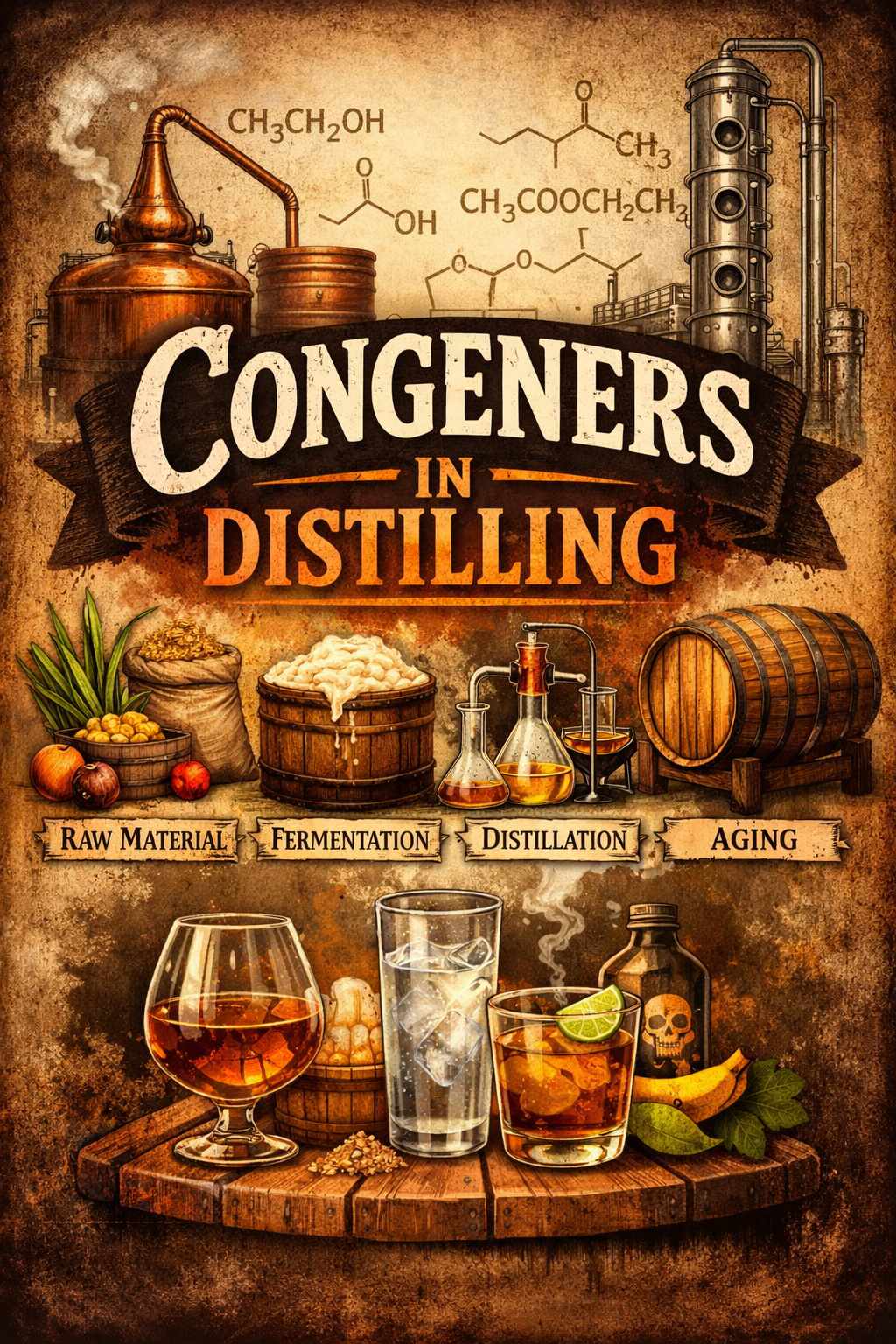
Congeners are the aroma, flavor, and texture compounds in a spirit that are not ethanol or water. They’re created primarily during fermentation, then separated and concentrated (or stripped away) during distillation. The goal isn’t “more congeners” or “less congeners” — it’s the right congener mix for the style of spirit being made.
At Timber Creek Distillery, that question shows up constantly in practice because equipment choice, copper contact, proof strategy, and cut decisions all change what makes it into the bottle. The same is true whether someone is building a bold whiskey, a clean rum, or a refined vodka.
1. What Congeners Are (In Plain English)
“Congeners” is a catch-all term for the many trace compounds that ride along with ethanol in a distilled spirit. These compounds include higher alcohols (often called fusel alcohols), esters, aldehydes, acids, sulfur compounds, and various trace phenolics. Some are desirable at low levels because they add depth; others are undesirable because they read as solvent, rubber, vegetal, or harsh heat.
If a spirit tastes neutral and “blank,” it usually means most congeners were intentionally removed through high rectification, filtration, or both. If a spirit has character — grain, fruit, spice, funk, smoke, or a long oily finish — that’s congeners showing up on purpose.
Congeners vs. ethanol
Ethanol is the main alcohol people associate with “proof.” Congeners are everything else (besides water) that makes the aroma and flavor feel like something specific. That difference is why a pot-distilled whiskey can feel rich and textured while a highly rectified neutral spirit can feel light and clean.
2. Where Congeners Come From
Congeners originate from three places: the raw material, the fermentation, and (if the spirit is aged) the barrel. Distillation mostly determines what gets selected and how concentrated it becomes.
Raw material and mash composition
Grain, sugarcane, fruit, and agave each carry different precursor compounds into fermentation, and that affects the “range” of congeners you can end up with. Grain spirits tend to express cereal sweetness, spice, toasted notes, and oiliness depending on mash bill and process. Timber Creek’s emphasis on grain character and separation shows up clearly in the distillery’s “grain-to-glass” approach described on the
About and Distillery pages.
Fermentation (the main congener factory)
Fermentation is where most congeners are created. Yeast doesn’t just produce ethanol and CO₂ — it also produces a huge set of secondary compounds as part of metabolism, stress response, nutrient balance, and temperature dynamics.
For example, warm or aggressive fermentations can push more ester production (fruity notes) and more higher alcohols (heavier “heat” and oil). Meanwhile, stressed yeast or nutrient imbalance can raise sulfur compounds that later need to be managed through copper contact and cut strategy.
Aging adds a second congener layer
When a spirit is aged, the barrel contributes additional congeners: vanillin, oak lactones, caramelized sugar compounds, and other extractives formed by toast and char. Aging also drives slow oxidation and esterification. This is part of why whiskey depth increases with time, especially when the original distillate enters the barrel with enough structure to “carry” wood influence.
3. The Major Congener Families (And What They Taste Like)
Higher alcohols (fusel alcohols)
These include compounds like propanol, butanol, and isoamyl alcohol. In small amounts they add weight and complexity. In excess they read as harsh, solventy, or hot. They tend to concentrate later in the run, meaning they’re often managed by tighter tails cuts and by distilling at an appropriate proof for the spirit style.
Esters
Esters are often the “good stuff” in moderation: fruit, floral, candy, tropical notes. They form when acids react with alcohols, and they’re influenced heavily by yeast strain, fermentation temperature, and time. Many rum and brandy styles intentionally chase ester development; a cleaner vodka target generally does not.
Aldehydes
Aldehydes commonly show up in the heads. Acetaldehyde can read as green apple at low levels and sharp/irritating at high levels. Because aldehydes are relatively volatile, they tend to appear early, so head cuts are one of the primary tools for controlling them.
Organic acids
Acids provide structure and are key inputs into ester formation. They can be a positive contributor to complexity, but in excess can become sour, sharp, or “vinegar-ish.” Many distillers think of acids less as a direct flavor and more as a lever that shapes ester potential and mouthfeel.
Sulfur compounds
Sulfur compounds can show up as struck match, cabbage, rubber, or meatiness depending on compound and concentration. Copper contact is a classic tool for reducing sulfur notes because copper binds certain sulfur compounds during vapor contact. This is one reason copper is still so central in traditional still design.
4. How Distillation Actually “Handles” Congeners
Distillation is not just “boil and collect.” It’s controlled separation. Different compounds have different volatilities and different behavior in ethanol-water mixtures. In practice, the distiller is using time, temperature, reflux behavior, and sensory evaluation to decide what becomes heads, hearts, and tails.
Heads, hearts, tails (and why cuts matter)
Heads tend to carry the lightest, most volatile compounds (including many aldehydes and some solventy esters). Hearts are where balance lives — ethanol plus the congeners that define the spirit’s intended character. Tails carry heavier alcohols and fatty compounds that can add texture at low levels but quickly become bitter, musty, or overly oily if pushed too far.
If you want a practical “visitor-friendly” view of how process choices show up in the final glass, the
Distillery Tour & Tasting
page is a natural internal jump because it frames the production walk-through and the tasting in one flow.
Pot still vs. column still (congener retention vs. removal)
Pot still distillation tends to retain more congeners because rectification is limited and the run is batch-based. Column stills can be tuned for far higher purity through multiple equilibrium stages (plates) and controlled reflux. That’s why high-rectification systems are often used to produce neutral spirits, while pot distillation is often preferred for expressive whiskey and rum styles.
Proof strategy changes what survives
Higher distillation proof generally strips congeners; lower distillation proof generally carries more congeners through. That proof strategy connects directly to style. For whiskey education and category context on your site, the recent post
What’s the difference between whiskey and bourbon?
is a solid internal bridge because it helps readers understand why “character” matters and where it comes from.
5. Controlling Congeners: What to Keep, What to Remove
The real distiller’s job is selective retention. A few practical levers matter more than anything else:
Fermentation controls
- Yeast choice: drives ester profile and higher alcohol tendencies.
- Temperature: warmer can increase ester/higher alcohol production; cooler can clean things up.
- Nutrients and oxygen management: affects sulfur risk and fermentation “stress.”
- Time: longer ferments can increase acid development and ester potential (style-dependent).
Still design and copper contact
Copper contact (in the pot, riser, lyne arm, or condenser path) is one of the classic ways to reduce certain sulfur compounds and smooth the vapor path. That basic “why copper matters” story also connects naturally to Timber Creek’s background in traditional design choices discussed in older process-focused posts like
Building Its Own Heritage in Northwest Florida.
Cut discipline
Heads and tails are where many problem congeners concentrate — but they also contain the compounds that can make a spirit feel alive if used carefully. A tight, clean heart cut produces a cleaner spirit. A slightly wider cut can build body and finish, but it raises the risk of harshness if the balance is off.
6. Congeners by Spirit Style (Why Vodka Isn’t Whiskey)
Different spirit categories implicitly define how many congeners the distiller is trying to retain.
Vodka
Vodka targets minimal congeners and minimal distinctive character. That usually means high rectification and/or treatment methods designed to reduce aroma and flavor compounds. (For category definitions, the TTB’s Beverage Alcohol Manual is the best “official” reference.)
Whiskey and bourbon
Whiskey and bourbon in particular does not pursue neutrality. It deliberately preserves and manages congeners from grain selection through fermentation, distillation, and barrel maturation. Unlike highly rectified spirits that strip flavor compounds away, whiskey production is engineered to retain esters, higher alcohols, organic acids, aldehydes, and grain-derived oils that create structure and depth. The mash bill establishes the chemical blueprint, with corn contributing sweetness and fatty acid precursors, rye adding phenolic spice, wheat softening texture, and malted barley supplying enzymatic power and nutty complexity. During fermentation, yeast generates a wide spectrum of flavor-active compounds that extend far beyond ethanol, forming the aromatic foundation of the spirit. Distillation then becomes a balancing act rather than a purification exercise—proof levels, cut points, and still design determine how many of those congeners survive into the new make. Finally, maturation in new charred oak—required for bourbon—transforms and integrates these compounds through extraction, oxidation, and esterification, layering vanillin, caramelized sugars, lactones, and toasted wood character onto the retained fermentation complexity. In this way, whiskey builds flavor cumulatively rather than subtractively; each stage is designed to carry congeners forward, refine them, and ultimately develop them into a cohesive, mature spirit.
Rum
Rum can range from very clean to very congener-rich, depending on fermentation length, yeast, and distillation style. Molasses-based ferments and longer ferment regimes can create a wide ester spectrum, especially when the producer is intentionally pushing “funk” or tropical fruit character.
7. Do Congeners Cause Hangovers?
Congeners often get blamed for hangovers, especially in darker spirits. The reality is simpler: ethanol is the primary driver of hangover symptoms. That said, higher congener loads can contribute to perceived severity for some people, and certain compounds (like higher alcohols) can be rough at elevated concentrations. The practical takeaway for a producer is the same: clean fermentation, smart copper contact, and disciplined cuts make a better spirit either way.
8. Two Solid External References (If Readers Want to Go Deeper)
- The Oxford Companion to Spirits & Cocktails dictionary entry on congeners (a clear, spirits-focused reference):
Spirits & Distilling: “congeners” - The U.S. Alcohol and Tobacco Tax and Trade Bureau (TTB) Beverage Alcohol Manual (useful for class/type definitions and regulatory language):
TTB: Beverage Alcohol Manual (PDF)