


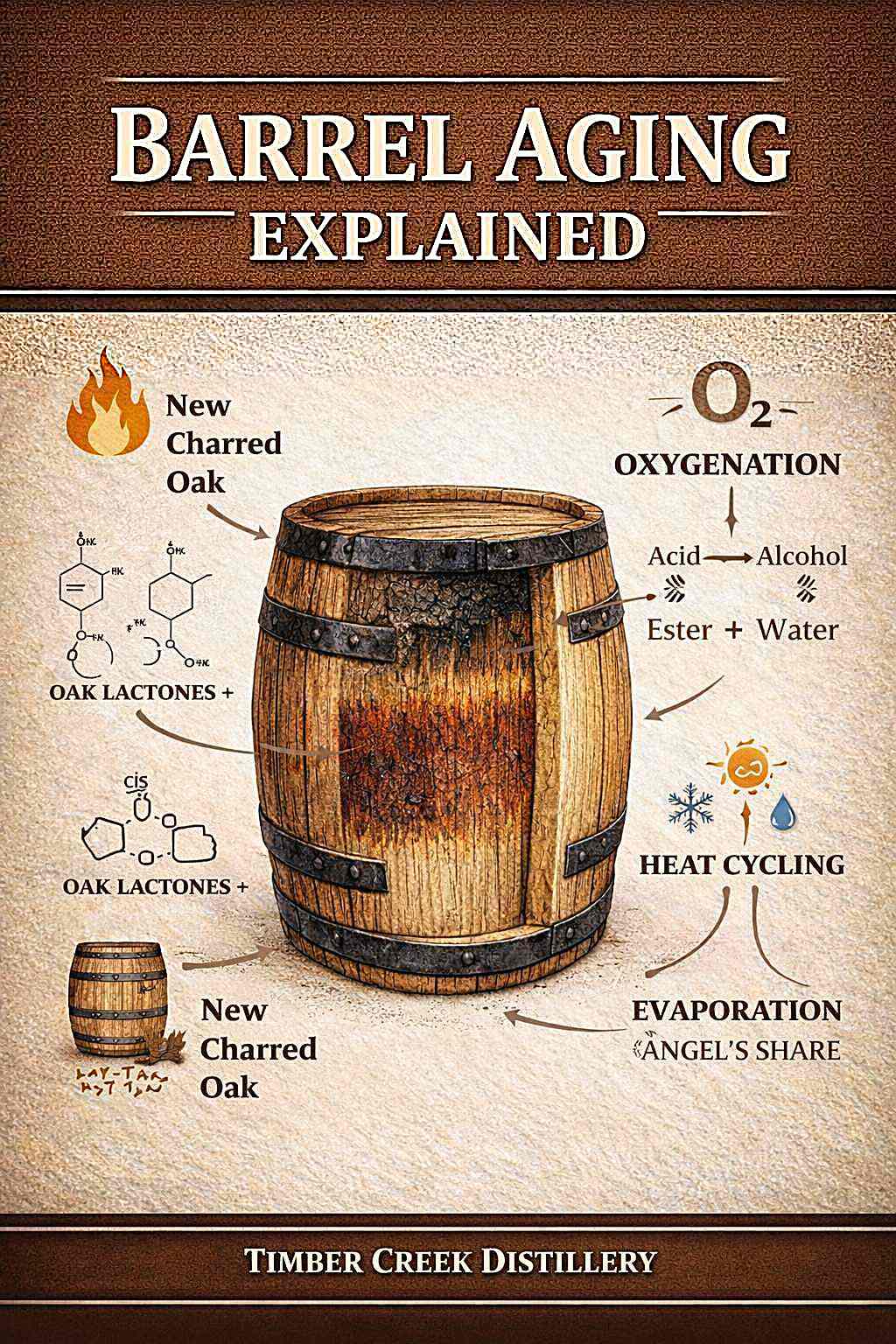
Barrel aging is not one single reaction. It is a moving overlap of extraction, filtration, oxidation, concentration, and slow chemical rearrangement, all governed by wood structure, char and toast chemistry, temperature swings, humidity, and time. People describe it as “the spirit breathing,” but the reality is more interesting: the barrel is a living composite material that behaves like a semi-permeable membrane, a reactive surface, and a temperature-driven pump.
This guide is written to be readable for curious drinkers, while still going deep enough to satisfy anyone who wants the real mechanics: what charred new American white oak contributes, why oxygen matters, how acids and alcohols form esters, what happens to oils and congeners over years, and why Florida heat cycling can mature a spirit differently than Kentucky rickhouse conditions.
1. What “Barrel Aging” Really Means (A Simple Map of a Complex System)
In practice, whiskey barrel aging is the sum of five big processes happening at once:
- Extraction: ethanol-water pulls compounds out of the wood: sugars, lactones, phenolics, tannins, aromatic aldehydes, and more.
- Adsorption + filtration: char and toasted layers trap, bind, or transform certain molecules (especially sulfur-bearing compounds and harsh phenolics).
- Oxidation + oxygenation: oxygen moves into the barrel system in tiny amounts; it drives slow oxidation of alcohols to aldehydes/acids and helps build complexity.
- Concentration: water and ethanol evaporate (angel’s share), changing proof and concentrating everything else.
- Time chemistry: acids + alcohols form esters, aldehydes participate in acetal formation, phenolics polymerize, and the entire aroma balance shifts.
Barrel aging is not “adding oak flavor” like steeping tea. It’s closer to cooking, curing, and slow oxidation in a controlled container—except the container is also a reactant.
2. Why New Charred American White Oak Is So Powerful
For American whiskey styles that require or prefer new charred oak, the wood is typically Quercus alba (American white oak). This species matters because it offers a rare combination of traits:
- Tyloses: balloon-like structures that plug vessels in the wood, reducing leakage and making it suitable for holding liquid.
- High lactone potential: precursors that yield coconut/woody sweetness (especially cis-oak lactone).
- Lignin and hemicellulose chemistry: abundant building blocks for vanilla, caramel, spice, and toast-derived aromatics.
- Tannin profile: enough structure to build body, but generally less aggressively tannic than some European oaks.
New oak is also “fresh” in a chemical sense: it hasn’t been depleted by a previous fill, so extraction is faster and more intense. When you add char, you create a carbon-rich layer plus a toasted zone beneath it, and that layered structure is the heart of modern American whiskey maturation.
3. Cooperage, Grain Direction, and Why Your Favorite Barrel Maker Matters
Not all barrels behave the same even if they are all “new charred American white oak.” Differences can come from:
- Oak source: soil, rainfall, growth rate, and stave seasoning affect tannins and aromatic precursors.
- Seasoning time: air seasoning reduces harsh green wood notes and changes extractable chemistry.
- Toasting protocol: time/temperature profiles determine how hemicellulose and lignin break down.
- Char method and consistency: flame intensity and duration affect char depth and the underlying toasted gradient.
- Cooperage craft: joint tightness, stave thickness, and how the barrel is assembled influence oxygen ingress and leak resistance.
When a distiller names a preferred cooperage—like our preference for McGinnis Wood Products (Cuba, Missouri)—that’s not just sentiment. It’s an implicit statement about repeatable wood behavior: how quickly the barrel gives up vanilla and caramel, how it handles tannin extraction, and how it breathes across seasons.
4. The Barrel’s Inner Architecture: Char Layer, Toasted Zone, Raw Wood
 Toasted Zone, Raw Wood
Think of the barrel interior as three functional layers:
- The char layer: a brittle carbonized surface, rich in activated-carbon-like structure.
- The toasted zone (“red layer”): wood heated enough to chemically transform hemicellulose and lignin, but not fully carbonize.
- Raw oak beneath: less altered wood that becomes relevant as the spirit penetrates deeper over time.
This layered gradient is why charred barrels do more than “add smoke.” They create a chemical factory: the toasted zone generates a library of aroma compounds, while the char layer can trap and smooth some undesirable notes, and the raw wood supports longer-term extraction and structure.
5. What Charring Does (Real Chemistry, Not Poetry)
Charring is a high-temperature surface treatment. It does several things at once:
- Creates a carbon matrix that can adsorb certain molecules (especially sulfur compounds and some harsh phenolics).
- Produces pyrolysis products—smoky, spicy, and roasted aromatics—though “smoke” is typically not the dominant note in well-aged whiskey unless char and toast are pushed aggressively.
- Opens micro-fractures that increase surface area and make it easier for spirit to move in and out of the wood with temperature changes.
- Establishes the red layer beneath char where most of the “vanilla/caramel/toast” chemistry is born.
Char level (#1 to #4 and beyond) is not just marketing. It changes extraction speed, the balance of sweet aromatics vs tannin, and the filtration effect of the char. Many bourbon-style programs rely on a #3 or #4 char because it tends to deliver strong sweetness and color development while still allowing structure.
6. What Toasting Does (And Why Toast vs Char Matters)
Toasting is a lower-temperature, longer-duration heat treatment compared to charring. Toasting favors a deeper breakdown of hemicellulose and selective transformation of lignin, often yielding:
- Caramel/baked sugar notes from hemicellulose-derived sugars and degradation products.
- Vanillin and related aldehydes from lignin transformation.
- Spice and toasted-nut aromatics depending on the toast curve.
Wine barrels tend to lean more heavily on toast without heavy char, because wine maturation prioritizes subtle oxygenation and tannin structure without carbon-heavy filtration. American whiskey maturation, especially in new barrels, leans on char + toast together to accelerate color, sweetness, and smoothing.
7. The Big Four Wood Families: Cellulose, Hemicellulose, Lignin, Extractives
Most of the barrel is made of structural polymers, plus a smaller but crucial fraction of extractives.
- Cellulose: the backbone fibers; relatively stable; contributes less directly to flavor.
- Hemicellulose: breaks down with heat into sugars and sugar-derived compounds that push caramel/toffee notes.
- Lignin: breaks down into aromatic aldehydes and phenolic compounds (vanillin is the headline, but it’s not alone).
- Extractives: fats, lactone precursors, tannins, and assorted small molecules that shape coconut/wood sweetness, structure, and bitterness.
If you want one mental model: hemicellulose feeds sweetness and browned-sugar aromatics, lignin feeds vanilla and aromatic complexity, and tannins/extractives shape structure and dryness.
8. Extraction: The Spirit as a Solvent (And Why Entry Proof Matters)
Whiskey in a barrel is a mixed solvent: ethanol + water. Ethanol is better at dissolving many aromatic compounds; water is better at dissolving others. The ratio changes what the spirit extracts.
Entry proof influences:
- Which compounds extract faster: higher ethanol tends to pull more wood aromatics and some phenolics; lower entry proof can pull a different balance of sugars and tannins.
- Mouthfeel development: extraction and subsequent polymerization change viscosity and perceived “roundness.”
- Perceived oak intensity: a high proof entry can sometimes read as sharper if tannin/phenolic extraction runs ahead of smoothing chemistry.
For a distillery like Timber Creek that controls distillation grain-to-glass and can tune distillate style (including a wheated bourbon-style whiskey), entry proof becomes part of the “recipe” for maturation. Barrel aging is not just time in wood; it’s spirit design meeting wood design.
9. The Barrel as a Semi-Permeable Membrane (Oxygenation Without Leaks)
Wood is not a sealed glass bottle. It is a composite material with microscopic pathways. It holds liquid because of structure and swelling, but it still allows slow movement of gases and vapor. That’s the core of the “barrel breathes” concept, and it’s not mystical.
Three important ideas:
- Oxygen ingress is slow but real: tiny amounts of oxygen enter the barrel system over time, influenced by wood porosity, stave thickness, humidity, and temperature cycling.
- Headspace matters: the air pocket in the barrel is a reactive zone; temperature changes expand and contract it, changing pressure and driving exchange.
- Spirit movement in/out of staves: as temperatures rise, the spirit expands and penetrates wood; as temperatures fall, it contracts and retreats—bringing extracted compounds back.
This is why climate is not a footnote. Climate is a pump.
10. Oxidation: Slow Transformations That Create Maturity
Oxidation in barrel aging is not the same as leaving a bottle open on a counter. In a barrel, oxygen is limited and arrives slowly. That’s good, because oxidation is powerful: it can build complexity or cause staleness depending on dose and context.
Common oxidation pathways include:
- Alcohols → aldehydes → acids: ethanol can oxidize to acetaldehyde and then acetic acid (in small, controlled amounts). Other alcohols and congeners follow similar logic.
- Phenolic oxidation: phenolics can oxidize and polymerize, changing bitterness/astringency and building color stability.
- Reactive aldehyde chemistry: aldehydes participate in further reactions that create complex aroma compounds and soften edges.
The point is not “oxidation adds flavor.” The point is “oxidation makes the system evolve.” Many notes people call “aged” or “integrated” come from oxidation-enabled rearrangements.
11. Esterification: How Acids and Alcohols Become Fruity, Floral, and Round
Esterification is one of the most misunderstood maturation processes because people hear “esters are fruity” and assume barrel aging simply increases fruitiness. It can, but the story is broader.
At its simplest, an ester forms when an acid and an alcohol react:
acid + alcohol ⇌ ester + water
Key points for readability:
- Esterification is slow at barrel temperatures, but years matter.
- The barrel supplies acids indirectly by enabling oxidation (which creates acids) and by contributing acidic compounds from wood and prior chemistry.
- Esters don’t just add “fruit”; they change aroma balance and perceived smoothness by rounding sharp notes and adding complexity.
Many “oily” perceptions in whiskey are from heavier congeners, fatty acids, and long-chain compounds. Over time, some of these can form esters or participate in reactions that make them smell less harsh and feel more integrated. Not all oils become esters, but esterification is one of the main routes by which harsh, sharp, or raw edges get rebalanced.
12. Acetals and “Smoothness” (The Quiet Chemistry People Taste but Can’t Name)
Aldehydes can react with alcohols to form acetals. In plain terms, acetals can reduce the sharp sensory impact of certain aldehydes by converting them into more stable forms. This matters because aldehydes can smell pungent, green, or prickly when out of balance.
In a mature whiskey, part of what people call “smoothness” is not just less harsh stuff—it’s the redistribution of reactive compounds into less aggressive ones. Barrel aging is chemical diplomacy.
13. Tannins, Astringency, and Why Over-Oaking Happens
Tannins provide structure and dryness, but they can also dominate. Astringency is not exactly bitterness; it’s the drying, puckering effect from tannins binding to proteins in saliva.
Over-oaking typically happens when:
- Extraction outruns integration: tannins and wood phenolics pull quickly, but smoothing chemistry needs time.
- Barrel size accelerates surface contact: smaller barrels increase surface-area-to-volume, speeding oak impact but not necessarily improving balance.
- Climate drives aggressive cycling: warm climates can accelerate extraction and evaporation, sometimes pushing oak too fast.
That last point is why Florida vs Kentucky is worth treating seriously.
14. Lactones: Coconut, Fresh Oak, and Why Some Barrels “Taste Like Oak” Faster
Oak lactones (especially cis– and trans-methyl-γ-octalactone) contribute coconut, woody sweetness, and fresh oak character. American white oak is known for robust lactone potential.
In readable terms: lactones are one of the reasons new American oak can taste immediately “bourbon-like” compared to many other wood regimens. The lactone contribution can be delightful—until it becomes one-dimensional. Balance matters.
15. Vanillin and the Lignin Family Tree (Vanilla Is Only the Start)
Vanillin is the celebrity, but lignin breakdown yields a whole cast of aromatic aldehydes and phenolics. Heat treatment (toast + char) shapes what becomes available for extraction, and oxidation over time continues to modify the aroma profile.
So when someone says, “the barrel adds vanilla,” the more accurate statement is: the barrel creates and releases a family of aromatics, and time plus oxygen reshapes them into a coherent aroma architecture.
16. Char as a Filter: Sulfur, Harsh Notes, and Why Char Matters Beyond Flavor
Fresh distillate can carry sulfur-bearing compounds or sharp notes depending on fermentation, distillation cuts, and equipment. Char can help because carbon-rich surfaces can adsorb certain compounds more readily than raw wood can.
This is one reason charred barrels can “smooth” a spirit that might otherwise need more time or different treatment. It does not magically fix everything, but it can reduce specific categories of harshness and help the distillate present cleaner over time.
17. The “Breathing” Cycle: Temperature, Pressure, and Spirit Migration
The barrel does not need to literally inhale and exhale like lungs to behave like a pump. Temperature swings are enough:
- Warm period: spirit expands, pressure changes, and liquid penetrates deeper into the wood’s microstructure.
- Cool period: spirit contracts, retreats, and carries extracted compounds back into bulk liquid.
That in-and-out movement is a key reason barrels mature spirits faster in places with large swings or consistent warmth—because the physical transport of compounds is more active.
18. Angel’s Share: Evaporation Is Not Just “Loss,” It’s a Driver
Evaporation changes proof, concentration, and reaction rates. What evaporates depends on temperature and humidity:
- Hot + dry environments tend to lose more water, increasing proof.
- Hot + humid environments can lose more alcohol relative to water, decreasing proof.
Either way, as volume drops, remaining congeners and wood-derived compounds become more concentrated. That can enhance complexity—or amplify flaws if the spirit is not structurally ready.
19. Florida vs Kentucky Aging: Same Barrel, Different Reality
Kentucky’s classic rickhouse environment has pronounced seasonal swings: warm summers, cold winters, and an established culture of multi-story warehouses where temperature gradients vary by floor. Florida’s Gulf Coast climate tends to be warmer for more of the year, with higher humidity and often smaller seasonal lows, depending on location and warehousing style.
What that can mean in practical terms:
- Extraction speed: Florida warmth can accelerate extraction, especially early in aging.
- Evaporation pattern: Higher humidity can push a different ethanol/water loss ratio than drier inland climates.
- Heat cycling frequency: Kentucky may deliver bigger seasonal swings; Florida may deliver more frequent warm-day cycles, with less dramatic winter reset.
- Risk of over-oaking: accelerated oak impact means barrel selection, entry proof, and monitoring become even more important.
For Timber Creek, this matters because it’s not enough to copy a Kentucky timeline and assume the same flavor curve. The wood is the same species, but the kinetics are not the same. Florida aging can be an advantage—if managed intentionally.
20. What Happens Over Time: Year 1 vs Year 4 vs Year 8 (A Useful Timeline)
Exact timing depends on barrel, proof, climate, and distillate. But the general pattern often looks like this:
Early stage (months to ~1–2 years): extraction dominates
- Rapid color pickup
- Strong oak aromatics: vanilla, caramel, coconut, toast
- Potential for harsh tannin spikes if the system runs hot
Middle stage (~2–5 years): integration chemistry becomes obvious
- Esterification and oxidation-driven balance increases
- Edges soften; “spirit heat” becomes less aggressive
- Oak becomes less “new lumber,” more “baked spice, vanilla, and structure”
Later stage (5+ years): concentration + polymerization + deep structure
- More pronounced dried fruit, nutty, rancio-adjacent notes can appear (depending on conditions)
- Tannin polymerization can shift astringency into a more integrated structure
- Risk increases: the barrel can start to dominate if the spirit doesn’t have enough core character
For a wheated bourbon-style distillate (like Timber Creek’s wheat-forward whiskey profile), the softer grain character can pair beautifully with vanilla, caramel, and gentle spice—but it also means barrel selection and monitoring matter, because a gentle distillate can be overwhelmed by aggressive oak if left too long in a highly active environment.
21. Distillate Matters: Barrel Aging Isn’t a Rescue Mission
Barrel aging can refine and elevate, but it rarely transforms a poorly designed distillate into greatness. Cuts, fermentation health, and the underlying congener structure determine what the barrel has to work with.
Grain-to-glass distilleries like Timber Creek have a unique advantage: they can adjust mash, fermentation, and cuts to produce a distillate that is built to age, not merely to survive aging.
22. The Myth of “Accelerated Aging” (And What Actually Can Be Accelerated)
Warmth and agitation can accelerate extraction, but they do not automatically replicate long-term integration chemistry. Many rapid-aging methods produce heavy oak impact without the same level of esterification/oxidation balance that time provides.
Things that can speed up:
- Extraction of wood compounds
- Color development
- Some adsorption/filtration effects
Things that resist shortcuts:
- Deep integration of aroma families
- Slow formation and rebalancing of esters and acetals
- Polymerization processes that change mouthfeel and structure
23. How to Talk About Barrel Aging Without Turning It Into Vibes
When you explain barrel aging to the public, the most accurate “plain English” framing is this:
- The barrel gives: vanilla, caramel, coconut, spice, toast, structure, and color.
- The barrel takes: some harshness (especially via char adsorption) and some raw edges.
- The barrel changes: it enables oxygen-driven chemistry that reshapes the spirit over years.
- The climate decides the pace: Florida and Kentucky do not run the same maturation schedule.
That’s the whole story—just unpacked at different depths.
24. Practical Barrel Aging Notes (Educational, Not a How-To for Illicit Distillation)
For legitimate distilleries, barrel programs are controlled like any other production system: documented fill proof, barrel lot tracking, warehouse positioning, sampling schedules, and sensory + analytical monitoring. The goal is not to “wait and hope.” It is to manage a slow, complex process with repeatable inputs and measured outputs.
25. Bringing It Home: A Timber Creek-Style Summary
In a new charred American white oak barrel—especially from a cooperage you trust—the distillate and the wood enter a long negotiation. The whiskey pulls sweetness, spice, and structure from toasted oak; char smooths and filters certain rough edges; oxygen ingress enables slow oxidation; acids and alcohols gradually form esters; and evaporation concentrates the whole system while climate controls the speed of every step.
For a grain-to-glass distillery in Florida working with wheated bourbon-style whiskey, the environment can accelerate some of the most important mechanisms—especially extraction and cycling—making barrel selection, entry proof, and monitoring even more important than simply “time in wood.” Done well, Florida heat doesn’t cheapen aging. It changes the kinetics. And kinetics, managed intentionally, can produce mature character with real depth.