

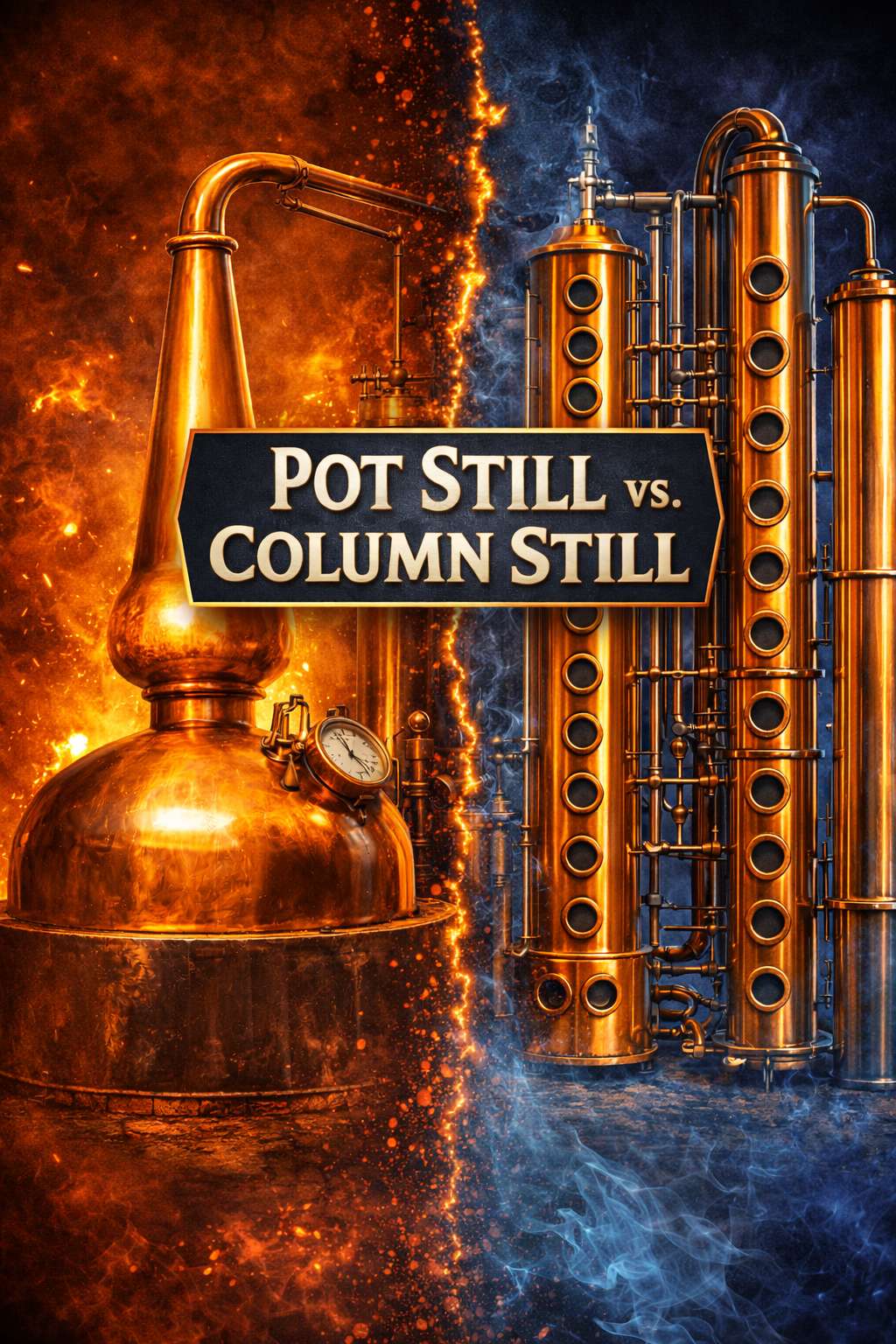
A pot still is a batch distillation system that separates alcohol through a single vaporization cycle, emphasizing flavor retention and congener complexity. A column still is a continuous distillation system that uses multiple equilibrium stages to increase purity, efficiency, and control. Both obey the same thermodynamic laws. The difference lies in engineering design, rectification capacity, and production goals.
I. Vocabulary and Foundational Definitions
Before comparing systems, precise terminology matters. Distillation language is often simplified in marketing, but the underlying physics and engineering deserve clarity. If you have already read How Distillation Works, this section expands that foundation into equipment-specific detail.
Distillation
Distillation is a thermal separation process based on differences in volatility. When a liquid mixture is heated, more volatile compounds enter the vapor phase at higher concentrations relative to the original liquid. That vapor is then condensed and collected. The governing principles include Dalton’s Law of Partial Pressures, Raoult’s Law, and vapor–liquid equilibrium dynamics.
Pot Still
A pot still is a batch distillation apparatus consisting of a boiler (the pot), a head or dome, a lyne arm, and a condenser. It processes a fixed charge of fermented liquid and completes separation over time. It does not contain engineered internal rectification stages unless modified with plates or retorts.
Column Still
A column still (continuous still) is a vertical distillation apparatus containing multiple equilibrium stages (plates or packing). It allows continuous feed input and continuous product output. Separation occurs across space rather than time.
Reflux
Reflux is condensed vapor that returns to the column or boiler rather than exiting as distillate. Increasing reflux increases separation efficiency and purity.
Rectification
Rectification refers to repeated vapor–liquid cycling inside a system. A column still is designed to maximize rectification. A traditional pot still achieves minimal rectification unless shaped to encourage passive reflux.
Theoretical Plate
A theoretical plate represents one equilibrium stage where vapor and liquid compositions equalize. Pot stills effectively operate with one to two theoretical plates. Column stills may operate with five to over one hundred.
II. The Physics Both Systems Share
Both systems operate under identical thermodynamic rules. The difference is not chemistry — it is engineering design.
During fermentation, yeast converts sugars into ethanol, carbon dioxide, and numerous secondary metabolites. Those fermentation decisions directly affect distillation outcomes, which is why understanding Fermentation for Distilling is critical before analyzing still design.
Once heat is applied:
- Ethanol vaporizes more readily than water.
- Lighter esters rise earlier in the run.
- Heavier fusel alcohols vaporize later.
- Relative volatility determines separation efficiency.
In a pot still, this separation unfolds gradually as alcohol concentration decreases during the run. In a column still, separation happens continuously and simultaneously at multiple stages.
III. The Historical Development of the Pot Still
The pot still predates industrial chemistry. Early alembics used by Islamic alchemists in the 8th–10th centuries evolved into copper pot stills used throughout Europe.
By the 17th century, pot distillation dominated production of:
- Scotch whisky
- Irish whiskey
- French brandy
- Caribbean rum
Copper became the material of choice due to its reactivity with sulfur compounds and superior thermal conductivity. That copper interaction remains central to flavor development today.
Even modern whiskey styles explained in What Is Whiskey? depend heavily on pot still behavior for character-driven production.
IV. The Industrial Revolution and the Rise of the Column Still
In 1830, Aeneas Coffey patented the continuous still. His design improved efficiency dramatically by allowing uninterrupted feed input and sustained equilibrium separation.
This innovation:
- Reduced fuel consumption
- Increased throughput
- Raised achievable alcohol purity
- Enabled neutral grain spirit production
Column distillation transformed global spirits production and made possible the large-scale neutral spirit required for products such as vodka, which is explored further in What Is Vodka?.
V. Pot Still Design: Types and Structural Variables
1. Onion-Shaped Pot Stills
Common in Scotch production, onion-shaped stills feature wide bases and tall, narrowing necks. Height encourages passive reflux. Heavier compounds condense and fall back into the boiler, resulting in lighter spirit.
2. Straight-Sided Pot Stills
These designs produce heavier, more robust distillate due to reduced reflux and shorter vapor paths.
3. Retort Pot Stills
Common in Jamaican rum, retorts add secondary vapor chambers that increase complexity while preserving pot character.
4. Boil Balls and Reflux Bulbs
Bulges in the neck promote additional copper contact and passive reflux. Each curvature alters vapor velocity and separation behavior.
5. Condenser Types
Worm tubs condense vapor rapidly and retain heavier congeners. Shell-and-tube condensers allow more refined control, often producing cleaner spirit.
VI. Column Still Engineering
1. Coffey Still (Two-Column System)
Composed of an analyzer column and a rectifier column, this design enables continuous alcohol separation.
2. Plate Columns
Each plate forces vapor to bubble through liquid, achieving equilibrium. More plates increase purity.
3. Packed Columns
Packing material increases surface area, enhancing vapor-liquid contact. This is common in high-purity vodka systems.
4. Dephlegmators
A dephlegmator acts as a partial condenser at the top of the column, controlling reflux and proof output dynamically.
VII. Pot Still vs. Column Still: Technical Comparison
| Variable | Pot Still | Column Still |
|---|---|---|
| Operation | Batch | Continuous |
| Reflux | Passive | Engineered |
| Congener Retention | High | Adjustable to Low |
| Efficiency | Lower | Higher |
| Energy Use | Higher per gallon | More efficient per gallon |
Pot distillation separates across time. Column distillation separates across space.
VIII. Flavor, Congeners, and Cut Strategy
In pot distillation, cuts between heads, hearts, and tails determine final character. These decisions are sensory-driven and influenced by fermentation variables described in Fermentation for Distilling.
Column stills allow more precise removal of heavier fusel oils and undesirable compounds. However, reducing reflux and plate count can retain flavor when desired.
After distillation, barrel interaction further transforms spirit, as explained in Barrel Aging Explained.
IX. Applications Across Spirits Categories
Whiskey
Many bourbons use column stripping followed by pot or doubler refinement, consistent with the legal and technical framework outlined in What Is Bourbon?.
Rum
Heavy Jamaican rum favors pot stills. Spanish-style rum favors columns.
Vodka
Primarily column distilled to achieve neutrality.
Gin
Often distilled in hybrid systems combining column-produced base spirit and pot botanical infusion, as discussed in What Is Gin?.
Fuel Ethanol and Industrial Alcohol
Exclusively column distilled for efficiency and purity.
X. Modern Hybrid Systems
Most modern craft distilleries employ hybrid systems:
- Pot base
- Removable plate columns
- Adjustable dephlegmators
- Modular reflux control
This flexibility allows a single system to produce whiskey, rum, gin, and vodka with distinct profiles.
XI. Philosophical Differences
Pot still philosophy emphasizes flavor, craftsmanship, and batch individuality. Column still philosophy emphasizes precision, scalability, and repeatability.
Neither system is inherently superior. Each serves different production goals.
XII. Conclusion
Pot stills and column stills obey identical physical laws. Their divergence lies in design architecture, rectification capacity, and production intent.
Pot stills prioritize character and congener retention. Column stills prioritize purity and efficiency. Modern distilling increasingly blends both approaches to achieve controlled flexibility.
Understanding both systems requires understanding distillation fundamentals, fermentation chemistry, and post-distillation maturation. Together, these processes define the structure and identity of the final spirit.