


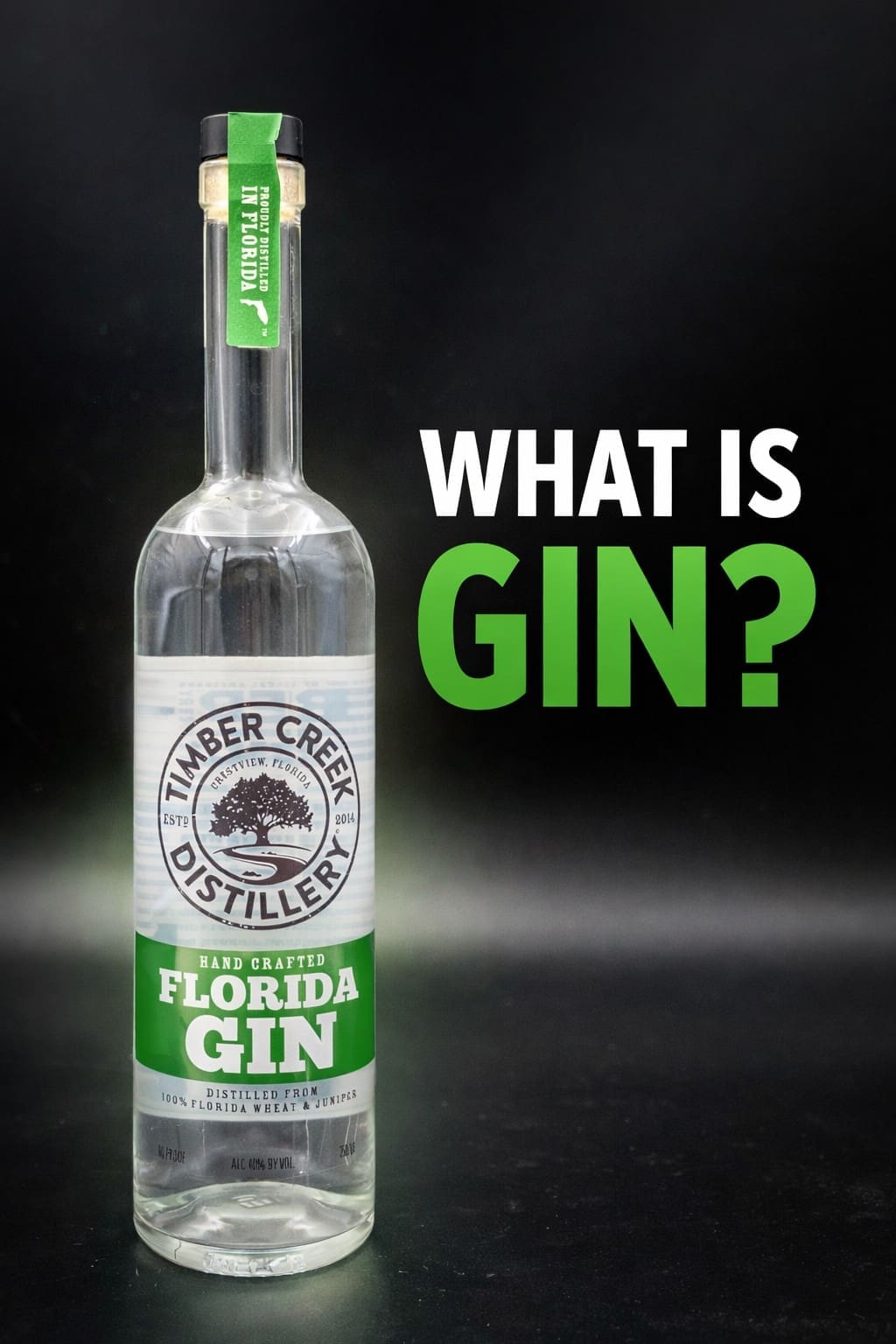
1. What Is Gin? The Straight Definition
What is gin? At its most basic level, gin is a distilled spirit defined by juniper. If juniper does not dominate the aroma and flavor, the spirit cannot legally be called gin. Everything else—grain choice, botanical blend, proof, aging—is secondary to that defining requirement.
Structurally, gin begins as a neutral spirit of agricultural origin. In that sense, gin resembles vodka. It is often described as a flavored neutral spirit. The difference is not casual flavoring. The difference is botanical identity and production discipline. Juniper must lead. The botanical composition must integrate. The final spirit must express balance rather than simple infusion.
Technically, gin is produced by distilling or redistilling neutral alcohol with juniper berries and other botanicals so that the finished spirit possesses the aroma and taste commonly attributed to gin. Unlike whiskey, which derives much of its identity from barrel aging, gin derives its character primarily from botanical extraction and distillation technique.
Readers who want deeper context on how neutral spirits are structured may find it helpful to review What Is Rum? An Authoritative Guide, which explains how base spirit selection and distillation precision shape final flavor outcomes across categories.
2. Is Gin Legally Defined?
Yes. Gin is legally defined in the United States, the European Union, and the United Kingdom. While terminology varies slightly, all jurisdictions agree on one essential rule: juniper must predominate.
United States (TTB Definition)
In the United States, gin is regulated by the Alcohol and Tobacco Tax and Trade Bureau (TTB). Federal regulations define gin as a distilled spirit produced by original distillation from mash, by redistillation of distilled spirits, or by mixing neutral spirits with juniper berries and other botanicals, so that it possesses the taste, aroma, and characteristics generally attributed to gin.
- Must originate from neutral spirit of agricultural origin
- Juniper must be the dominant character
- No minimum aging requirement
- No geographic restriction
- Minimum bottling strength: 40% ABV (80 proof)
The full regulatory framework can be reviewed in the TTB Beverage Alcohol Manual and the Code of Federal Regulations, Title 27.
European Union and United Kingdom
In the European Union, Regulation (EU) 2019/787 defines gin and establishes subcategories such as Gin, Distilled Gin, and London Gin. The minimum bottling strength is 37.5% ABV. London Gin, in particular, cannot contain artificial flavors, added color, or significant sweetening.
The UK retained these definitions post-Brexit. The regulatory text can be found through the EU Spirits Regulation database and UK spirits regulations.
Although the wording differs between jurisdictions, the structural principle remains consistent: gin is defined by juniper and botanical distillation, not by region.
For readers unfamiliar with alcohol strength terminology, understanding proof and ABV is foundational. The glossary in Distillery and Whiskey Vocabulary clarifies these measurement standards in technical detail.
3. The Big Picture: Where Gin Fits in the Spirits World
Gin belongs to the distilled spirits family. It is not a fermented beverage like wine or beer. It begins as a high-proof neutral alcohol and becomes gin only after botanical distillation.
Compared to whiskey, gin is structurally different. Whiskey depends heavily on barrel aging and grain character. The distinctions between whiskey styles are explored in What’s the Difference Between Whiskey and Bourbon?. Gin, by contrast, depends on botanical chemistry and distillation precision rather than wood interaction.
At Timber Creek Distillery, gin is produced using a pot still rather than a column still. Instead of distilling all botanicals together in a single vapor pass, each botanical is distilled individually and then blended. This method treats each ingredient as a distinct component rather than a background infusion. The philosophy mirrors the broader grain-to-glass mindset described in Grain-to-Glass Distillation Process, where process control defines quality.
Most commercial gin producers rely on column distillation for efficiency. Pot distillation allows greater control over cut points and botanical intensity. Individual botanical distillation further isolates volatile compounds, allowing precise blending after distillation rather than during vapor extraction.
Understanding what gin is requires understanding this distinction. Gin is not simply flavored vodka. It is a neutral spirit transformed through controlled botanical extraction and careful distillation choices.
4. A Brief but Structurally Important History of Gin
Understanding what gin is today requires examining how gin evolved. Gin did not begin as a neutral botanical spirit. It developed gradually through changes in distillation technology, regulation, and trade.
Dutch Genever: The Structural Ancestor
Gin traces its origin to genever in the Netherlands during the 16th and 17th centuries. Genever was originally distilled from malt wine and flavored with juniper for medicinal purposes. Early expressions were heavy, grain-forward, and closer in structure to young whiskey than to modern London Dry gin.
Juniper was used both for perceived health benefits and for flavor stabilization. As distillation methods improved, genever became cleaner and more refined, but it retained a malt character that distinguishes it from contemporary gin.
The English Adaptation
English soldiers encountered genever during military campaigns in the Low Countries. Upon returning to England, distillers began producing their own version. Grain-neutral spirit became more accessible, and juniper flavoring became simplified.
The 18th-century “Gin Craze” in London reflected cheap production and limited regulation. Poor-quality gin flooded the market. Public health issues led to the Gin Acts, which gradually imposed licensing and production standards. These reforms laid groundwork for quality-focused distillation.
Archival materials from institutions such as the British Library document the social and regulatory context of this period.
The Column Still and the Rise of London Dry
The invention of the continuous column still in the 19th century transformed gin permanently. Column distillation allowed producers to create highly neutral spirit efficiently and consistently. This technical shift removed heavy congeners and allowed botanical flavor to sit on a cleaner canvas.
The result was London Dry gin: lighter, sharper, and structurally dependent on botanical layering rather than grain character.
The broader technological shift in distillation is explored in Grain-to-Glass Distillation Process, which outlines how still design influences flavor outcome across categories.
Modern Craft Revival
The late 20th and early 21st centuries saw a revival in small-scale gin production. Craft distilleries began experimenting with local botanicals, lower throughput stills, and alternative distillation techniques.
Unlike large industrial producers that prioritize efficiency, many small producers returned to pot stills for greater aromatic control. This shift reintroduced variability, botanical experimentation, and stylistic diversity.
Gin today is one of the most diverse spirit categories globally, ranging from traditional juniper-dominant expressions to contemporary botanical-forward styles.
5. Ingredients: What Gin Is Made From
To fully answer the question “What is gin?” it is necessary to examine the ingredients that shape its structure. Gin is simple in category definition but complex in composition.
The Neutral Base Spirit
Gin begins with neutral spirit distilled from agricultural raw materials. In the United States, this typically means grain such as corn, wheat, or rye. The neutral spirit is usually distilled to high proof—often near 95% ABV—to remove most congeners.
This high-proof base provides a blank aromatic platform. It does not carry the grain character that defines whiskey, as detailed in What’s the Difference Between Whiskey and Bourbon?. Instead, it functions as a solvent for botanical extraction.
Juniper: The Defining Botanical
Juniper berries contain volatile compounds such as alpha-pinene and sabinene. These compounds produce pine, resin, and citrus-like aromatics. Without these oils, gin loses its defining character.
Legally and structurally, juniper must dominate. Other botanicals may complement it, but they cannot replace it.
Secondary Botanicals
Beyond juniper, botanicals may include coriander, angelica root, citrus peel, orris root, cassia, cardamom, lavender, and countless others. Each botanical contributes specific volatile compounds that vaporize during distillation.
At Timber Creek Distillery, each botanical is distilled individually in a pot still before blending. This differs from the more common vapor-infusion method where all botanicals are distilled together. Individual distillation isolates volatile fractions and allows controlled recombination during blending.
This approach mirrors the precision-oriented philosophy described in Distillery and Whiskey Vocabulary, where cut points and component management determine structural integrity.
Water
Water is used both before and after distillation. Before distillation, it adjusts proof for optimal botanical extraction. After distillation, it reduces the spirit to bottling strength.
Mineral composition influences mouthfeel. Even when flavor differences are subtle, dissolved solids can affect perceived texture.
Additives and Sweetening
Some gin categories permit minor sweetening. London Gin, under EU and UK rules, restricts sweetening to minimal levels and prohibits artificial flavors and added color. The regulatory standards can be reviewed through the EU spirits regulation database and the TTB Beverage Alcohol Manual.
6. How Gin Is Made: A Technical Breakdown
What is gin from a production standpoint? Gin is neutral spirit transformed through botanical distillation and precise blending. The method used determines structural character.
Step 1: Neutral Spirit Production
When produced in-house, grain is milled, mashed, fermented, and distilled. Fermentation typically lasts several days and produces ethanol along with trace congeners.
The fundamentals of fermentation and distillation are discussed in depth in Grain-to-Glass Distillation Process, which outlines how raw material handling influences final spirit clarity.
Step 2: Botanical Distillation
There are three primary gin production methods:
- Redistillation with botanicals in the pot
- Vapor infusion using botanical baskets
- Compound blending without redistillation
At Timber Creek Distillery, botanicals are distilled individually in a pot still. Each run captures a specific aromatic profile. These individual distillates are then blended in controlled ratios.
This method differs from column still vapor infusion, where botanical interaction occurs simultaneously during a single distillation pass. Individual botanical distillation allows separation of volatile fractions and post-distillation compositional control.
Step 3: Cut Points
As in whiskey production, cut points matter. Heads may carry sharp or solvent-like notes. Hearts contain balanced botanical expression. Tails may introduce bitterness or heaviness.
Although gin is not aged like whiskey, precision in cuts is just as critical. The importance of cut discipline is also discussed in What’s the Difference Between Whiskey and Bourbon?, where structural integrity is similarly dependent on distillation choices.
Step 4: Blending and Proofing
After distillation, botanical distillates are blended to achieve the intended profile. Proofing is done gradually to prevent precipitation of essential oils.
Final bottling strength must comply with jurisdictional requirements: 40% ABV minimum in the United States and 37.5% ABV minimum in the European Union.
7. Styles of Gin: Structural Differences, Not Just Flavor Differences
Answering the question “What is gin?” requires more than defining juniper. Gin is not a single style. It is a category with distinct structural subtypes, each defined by production method rather than branding language.
London Dry Gin: Process Discipline Over Geography
London Dry gin is frequently misunderstood as a regional product. In reality, London Dry is a production classification. It may be made anywhere in the world, provided it meets strict compositional requirements.
Under EU and UK law, London Gin must:
- Be distilled with all botanicals present during distillation
- Contain no artificial flavorings
- Contain no added color
- Contain no sweetening beyond trace levels
All flavor must be derived from distillation. This requirement prohibits post-distillation flavor correction, which makes production precision critical.
From a structural standpoint, London Dry is typically crisp, juniper-forward, and restrained in sweetness. Citrus and coriander often support the backbone.
Distilled Gin (U.S. Category)
In the United States, “distilled gin” refers to gin that has been redistilled with botanicals. This separates it from compound gin, where botanical extracts may be blended into neutral spirit without redistillation.
Distilled gin generally exhibits better integration because volatile oils are captured during vapor phase rather than added afterward.
Compound Gin
Compound gin is produced by adding botanical extracts or essences directly into neutral spirit. While legally acceptable in the U.S., compound gin is often considered structurally inferior because botanical oils are not integrated through distillation.
Without vapor interaction, the spirit may lack cohesion. Botanical sharpness may remain separate rather than harmonized.
Genever: The Malted Predecessor
Genever differs significantly from modern gin. It contains malt wine, a low-proof grain distillate that retains grain character. This gives genever a heavier body and subtle sweetness.
Unlike contemporary gin, genever often exhibits cereal notes similar to unaged whiskey. The distinction between malt-forward spirits and neutral botanical spirits mirrors the broader structural differences explained in What’s the Difference Between Whiskey and Bourbon?.
Contemporary or “New Western” Gin
Modern craft gin producers sometimes reduce juniper dominance in favor of floral, citrus, or herbaceous botanicals. While juniper must still legally predominate, its sensory dominance may be more restrained.
This style shift reflects consumer demand for softer botanical profiles rather than pine-forward intensity.
Aged Gin
Aged gin is matured in oak barrels for varying periods. While not required, aging introduces vanillin, lactones, tannins, and oxidative compounds that reshape the botanical profile.
Unlike whiskey, where aging defines category identity, gin aging is elective and stylistic.
8. Distillation Science: Pot Still vs Column Still in Gin Production
What is gin from a distillation perspective? It is a neutral base spirit transformed by botanical extraction under controlled thermal conditions. The still design influences that transformation.
Column Still Production
Column stills allow continuous distillation. They are efficient, high-throughput, and capable of producing highly neutral alcohol. Many large producers use column stills to create base spirit and sometimes for botanical distillation.
Column distillation emphasizes efficiency and uniformity. Botanical extraction may occur in vapor baskets within a column structure.
Pot Still Production
Pot stills operate in batch mode. They allow more control over cut points and temperature curves. Pot distillation can preserve heavier botanical oils that column systems may strip away.
At Timber Creek Distillery, gin is produced in a pot still. Each botanical is distilled individually before blending. This approach isolates aromatic fractions and allows blending after distillation rather than during it.
Instead of allowing all botanicals to interact simultaneously in vapor phase, individual distillation creates discrete components. These components are then recombined to achieve balance.
This philosophy parallels the broader grain-to-glass approach detailed in Grain-to-Glass Distillation Process, where precision at each stage determines final integrity.
Cut Points and Volatile Management
During distillation, volatile compounds evaporate at different temperatures. Heads often contain acetaldehyde and ethyl acetate. Hearts contain ethanol and desirable botanical oils. Tails may carry fusel oils and heavier compounds.
Managing cut transitions is essential. Poor cuts introduce harshness. Conservative cuts reduce yield but improve refinement.
Gin, though not barrel-aged, requires cut precision comparable to whiskey distillation. Structural discipline defines quality more than marketing claims.
9. Botanical Chemistry: Why Gin Tastes the Way It Does
Gin flavor originates from volatile aromatic compounds extracted during distillation.
Terpenes
Juniper is rich in terpenes such as alpha-pinene and limonene. These compounds produce pine, citrus, and resin characteristics.
Esters
Esters contribute fruit-like aromas. Their concentration depends on both fermentation and botanical composition.
Phenolic Compounds
Spice notes from coriander and cassia arise from phenolic compounds. These add warmth and structural dryness.
Fixatives
Angelica root and orris root act as fixatives. They help bind volatile compounds and extend aromatic persistence.
Understanding these compound families clarifies why gin behaves differently from spirits such as rum, whose structural foundation is explained in What Is Rum? An Authoritative Guide. Rum derives complexity from fermentation congeners and aging, while gin derives it from botanical volatility.
10. International Regulatory Nuance: Where Definitions Subtly Diverge
While all major jurisdictions agree that juniper must predominate, the legal structure surrounding gin varies in meaningful ways. Understanding these differences clarifies not only what gin is, but how producers must legally structure it.
United States: Category Flexibility
Under U.S. law, gin may be produced by distillation or by blending neutral spirit with juniper and other botanicals. This flexibility allows both redistilled and compound methods within the same broad classification.
The regulatory language emphasizes the finished product’s “taste, aroma, and characteristics generally attributed to gin.” This phrasing allows stylistic variation while preserving juniper dominance as the defining threshold.
The full regulatory framework is outlined in the TTB Beverage Alcohol Manual and Title 27 of the Code of Federal Regulations.
European Union: Subcategory Precision
EU Regulation (EU) 2019/787 introduces clearer subcategory distinctions. “Gin,” “Distilled Gin,” and “London Gin” carry progressively stricter compositional requirements. In particular, London Gin must not contain artificial flavorings or color and must derive all flavor from distillation.
This regulatory precision limits post-distillation manipulation and emphasizes process discipline. The legal framework is available through the EU spirits regulation database.
United Kingdom: Continuity Post-Brexit
Following Brexit, the United Kingdom retained EU-derived gin definitions in domestic legislation. London Gin remains tightly controlled, and labeling requirements continue to mirror EU standards.
Regulatory references can be found through UK government spirits regulations.
Minimum Alcohol Strength
The minimum alcohol strength for gin is 40% ABV in the United States and 37.5% ABV in the European Union and United Kingdom. These thresholds ensure aromatic volatility and structural integrity.
Understanding alcohol strength measurement requires familiarity with proof systems, which are explained in Distillery and Whiskey Vocabulary.
11. Sensory Evaluation: How to Assess Gin Structurally
Evaluating gin requires more than identifying flavor notes. It requires assessing balance, integration, and structural coherence.
Aroma Assessment
The nose should immediately reveal juniper presence. Secondary botanicals should support rather than dominate. Sharp ethanol or solvent notes may indicate poor cut management.
Palate Structure
On the palate, gin should exhibit clarity and layered botanical progression. Juniper typically forms the backbone. Citrus often appears mid-palate. Root botanicals may extend into the finish.
A well-made gin will not taste disjointed. Botanicals should not appear separate or artificially imposed.
Finish
Length of finish correlates with botanical oil concentration and proof. Higher proof gins often carry longer aromatic persistence.
Fault Identification
- Harshness: Often indicates aggressive heads inclusion.
- Bitterness: May result from excessive tails.
- Flat aromatics: Suggest over-filtration or weak botanical charge.
- Artificial sharpness: Possible compound gin imbalance.
While gin does not rely on aging the way whiskey does, quality evaluation parallels structural discipline discussed in What’s the Difference Between Whiskey and Bourbon?, where production control determines integrity.
12. Quality Diagnostics: What Separates Exceptional Gin from Average Gin
Quality in gin can be measured across several production dimensions.
Botanical Freshness
Oxidized botanicals produce muted aromatics. Fresh juniper is resinous and bright. Coriander should present citrus lift rather than dusty spice.
Distillation Precision
Precise cut management eliminates solvent notes while preserving aromatic complexity. Pot still distillation allows greater cut control than continuous column systems.
Botanical Integration
Integrated gin feels cohesive. Compound gin may present layered but separate flavors. Individually distilled botanical blending, as practiced at Timber Creek Distillery, allows structural control over integration.
Proofing Discipline
Rapid proofing can cause oil precipitation and aromatic suppression. Gradual dilution preserves volatility.
Water Chemistry
Mineral composition affects texture. Soft water tends to produce smoother perception, while higher mineral content can create sharper mouthfeel.
13. Expanded Myths and Corrections About Gin
- Myth: Gin is simply flavored vodka.
Correction: While gin begins with neutral spirit similar to vodka, it is legally defined by juniper dominance and botanical distillation discipline. - Myth: All gin tastes like pine.
Correction: Juniper creates pine notes, but coriander, citrus peel, and other botanicals significantly modify profile. - Myth: Higher proof gin is harsher.
Correction: Higher proof can enhance aromatic clarity when distillation is properly executed. - Myth: Pot still gin is automatically superior.
Correction: Still type alone does not guarantee quality. Cut management and blending discipline determine outcome. - Myth: London Dry means produced in London.
Correction: It is a process classification, not geographic origin. - Myth: Barrel-aged gin is not real gin.
Correction: Aging is stylistic and does not negate category identity. - Myth: Gin must be crystal clear.
Correction: Some gins may show light color if barrel-rested. - Myth: Gin is easier to produce than whiskey.
Correction: Botanical precision and cut management require technical expertise comparable to aged spirits. - Myth: All botanicals are distilled together.
Correction: Some producers distill botanicals individually before blending. - Myth: Sweet gin is low quality.
Correction: Style preference does not determine structural quality.
14. How to Choose Gin: Structural Buying Guide, Not Marketing Advice
Understanding what gin is allows buyers to evaluate bottles based on structure rather than label language. The most reliable indicators of quality are production transparency, botanical balance, and distillation discipline.
1. Examine the Production Method
Does the producer specify whether the gin is distilled, vapor-infused, or compound? Distilled gin generally indicates botanical integration through redistillation. Compound gin may be perfectly acceptable but often lacks the cohesion of vapor-phase extraction.
Producers who describe still type, cut practices, or botanical handling demonstrate process transparency. Transparency correlates strongly with production control.
2. Evaluate Juniper Presence
Juniper must dominate legally, but stylistic dominance varies. A buyer seeking classic structure should look for London Dry labeling. Those preferring softer botanical balance may gravitate toward contemporary styles.
3. Consider Alcohol Strength
Gin bottled at higher proof (45–50% ABV) often delivers stronger aromatic lift. Dilution suppresses volatile compounds. Higher proof does not indicate harshness when properly distilled.
4. Assess Botanical Philosophy
Some producers distill botanicals simultaneously. Others distill them individually and blend post-distillation. Individual botanical distillation allows discrete control over volatile fractions and can create greater structural clarity.
The discipline required for this approach parallels the process precision discussed in Grain-to-Glass Distillation Process, where each stage is treated independently before final composition.
5. Ignore Undefined Marketing Terms
Terms such as “craft,” “small batch,” and “artisanal” carry no legal definition. Production transparency is more meaningful than label aesthetics.
6. Price Bands and Expectations
Lower-priced gin often prioritizes efficiency. Mid-range gin typically offers balanced botanical structure. Higher-priced gin may reflect lower production volume, rare botanicals, or specialized distillation methods. However, price alone does not guarantee quality.
15. How Gin Is Used: Functional and Chemical Perspective
Gin’s botanical structure makes it uniquely adaptable in both cocktails and culinary applications. Its volatile compounds respond dynamically to dilution and acidity.
Gin and Tonic
Quinine bitterness in tonic water interacts with juniper terpenes. Carbonation enhances aroma release. Dilution reduces ethanol perception while amplifying citrus oils.
Martini
In a Martini, gin provides structural backbone. Vermouth introduces acidity and herbal integration. The ratio alters botanical dominance.
Negroni
The Negroni demonstrates gin’s structural resilience. Bitter liqueur and vermouth would overwhelm a neutral spirit. Gin’s botanical intensity maintains balance.
Tom Collins
Citrus acidity in a Tom Collins interacts with juniper and coriander compounds, lifting aromatics through dilution and carbonation.
Culinary Use
Gin performs well in marinades and reductions due to volatile herbal compounds. Citrus-forward gins complement seafood. Spice-forward gins pair with roasted vegetables.
Unlike whiskey or rum, which derive structural weight from fermentation congeners and barrel extraction, gin’s adaptability comes from botanical volatility. Readers comparing spirit behavior across categories may revisit What Is Rum? An Authoritative Guide for structural contrast.
16. Storage and Oxidation Science
Gin is shelf-stable due to high alcohol concentration. However, botanical volatility makes it sensitive to environmental factors.
Unopened Storage
Unopened gin can remain stable for years if stored upright in a dark environment. Ethanol concentration prevents microbial growth.
Opened Bottles
Once opened, oxygen gradually interacts with volatile oils. Over time, aromatic intensity may decline. This does not constitute spoilage but can alter sensory expression.
Light Exposure
Ultraviolet light degrades certain botanical compounds. Clear bottles should be stored away from sunlight.
Temperature Stability
Extreme temperature fluctuations can affect closure integrity and aromatic stability. Consistent ambient storage is recommended.
17. Technical Glossary Specific to Gin
- Juniperus communis: The botanical species that defines gin.
- Terpenes: Volatile compounds responsible for pine and citrus aromatics.
- Fixatives: Botanicals that stabilize volatile compounds (e.g., angelica root).
- Vapor Infusion: Passing alcohol vapor through botanical baskets during distillation.
- Compound Gin: Gin produced by blending botanical extracts into neutral spirit without redistillation.
- London Gin: EU-defined category with strict compositional rules.
- Cut Points: Distillation transitions separating heads, hearts, and tails.
- Proofing: Diluting distilled spirit to bottling strength.
18. Quick Reference Summary: What Gin Is and What It Is Not
- Gin is a distilled spirit defined by juniper dominance.
- It begins as neutral spirit of agricultural origin.
- Juniper must predominate under U.S., EU, and UK law.
- Minimum bottling strength: 40% ABV (U.S.), 37.5% ABV (EU/UK).
- London Dry is a production method, not a location.
- Gin may be redistilled, vapor-infused, or compound.
- Botanical chemistry defines flavor structure.
- Pot still production allows greater cut control.
- Individual botanical distillation permits blending precision.
- Gin is typically unaged but may be barrel-rested.
- Quality depends on botanical freshness and cut discipline.
- Storage affects aromatic longevity but not microbial stability.
- Gin is structurally distinct from whiskey and rum.
- What gin is can be understood through ingredients, production, regulation, and chemistry—not mythology.
19. Gin vs. Vodka vs. Whiskey: Structural Comparison
To fully understand what gin is, it helps to compare it directly with adjacent spirit categories. Gin, vodka, and whiskey all begin with fermentation and distillation. Their divergence occurs after neutral spirit production.
Gin vs. Vodka
Vodka is defined by neutrality. U.S. law describes vodka as distilled to high proof and treated to be without distinctive character, aroma, taste, or color. Its goal is refinement and minimal expression.
Gin begins at the same structural starting point—a neutral spirit—but intentionally introduces botanical identity. Where vodka removes flavor-active compounds, gin introduces them.
The structural differences between neutral spirits and flavor-forward spirits are explored in What Is Rum? An Authoritative Guide, which explains how fermentation congeners shape category identity in other spirits.
In simple terms, vodka subtracts. Gin subtracts first, then rebuilds through botanical distillation.
Gin vs. Whiskey
Whiskey derives identity primarily from grain composition and barrel maturation. Oak interaction introduces vanillin, lactones, tannins, and oxidative complexity. The distinctions between whiskey styles are outlined in What’s the Difference Between Whiskey and Bourbon?.
Gin does not rely on barrel aging. Its character is established before bottling. There is no long-term oxidative development. Instead, gin is defined by botanical chemistry and distillation precision.
Whiskey evolves over years. Gin expresses its complete identity immediately after distillation and proofing.
Why This Comparison Matters
Understanding these differences clarifies why gin production requires a distinct technical mindset. It is not aged refinement. It is immediate compositional control.
20. Advanced Botanical Extraction Science
Botanical extraction in gin is governed by volatility, solubility, and temperature gradients. Different compounds vaporize at different rates and dissolve differently in ethanol-water mixtures.
Volatility and Boiling Points
Ethanol boils at 78.37°C (173°F), but botanical compounds vary widely. Lighter terpenes vaporize early. Heavier compounds may require longer exposure or higher temperatures.
Distillers must balance heat input and time to prevent harsh compounds from entering the hearts cut.
Maceration vs. Vapor Infusion
Maceration involves soaking botanicals in neutral spirit before distillation. This increases extraction efficiency but may introduce heavier compounds if not carefully controlled.
Vapor infusion passes alcohol vapor through botanicals suspended in baskets. This often produces lighter, brighter aromatics.
Individual Botanical Distillation
Distilling each botanical separately isolates its volatile profile. This method allows post-distillation blending, similar to component blending in whiskey production, though without barrel influence.
At Timber Creek Distillery, each botanical is distilled individually in a pot still before blending. This isolates aromatic fractions and allows precise structural assembly. Rather than allowing botanicals to compete during vapor phase extraction, they are treated as individual components.
Solubility and Proof Management
Botanical oils dissolve differently depending on alcohol concentration. At higher proof, more oils remain in solution. When proof is reduced, certain oils may precipitate, creating haze.
Gradual proof reduction preserves clarity and aromatic integration. Rapid dilution increases the risk of louching.
21. Production Troubleshooting: Where Gin Goes Wrong
Even small errors during production can produce noticeable structural flaws.
Over-Extraction
Excessive maceration or prolonged distillation may introduce bitterness from root botanicals or harsh phenolics from spices.
Poor Cut Management
Including too much heads fraction introduces solvent-like sharpness. Excess tails introduce bitterness or muddy texture.
Botanical Imbalance
Too little juniper fails legal and structural thresholds. Too much coriander may create overpowering spice. Insufficient fixatives may produce short finish.
Water Chemistry Errors
High mineral content may produce harsh mouthfeel. Sudden proofing changes may suppress aromatic volatility.
Filtration Overreach
Aggressive chill filtration can strip aromatic oils, flattening complexity.
These production risks mirror precision concerns discussed in Distillery and Whiskey Vocabulary, where small technical decisions shape final integrity.
22. Global Trade and the Expansion of Gin
Gin’s modern identity cannot be separated from trade history. British maritime expansion carried gin globally. Tonic water, originally consumed for quinine delivery in malaria-prone regions, became a defining mixer.
Global trade routes introduced citrus peels, spices, and botanicals from Asia, Africa, and the Caribbean into European gin production. This botanical diversity expanded stylistic possibilities.
The intersection of trade, distillation technology, and regulation explains why gin evolved differently from regionally protected spirits such as Scotch whisky.
23. The Future of Gin
Modern gin continues to evolve through experimentation with regional botanicals, proof variations, and alternative distillation approaches.
Some producers explore vacuum distillation to preserve delicate floral compounds. Others experiment with aging or hybrid distillation methods.
Despite stylistic experimentation, the legal and structural definition remains unchanged: juniper must predominate.
24. Juniper: Botany, Sourcing, and Agricultural Variables
If gin is defined by juniper, then understanding juniper itself becomes essential to understanding what gin is.
Juniperus Communis
The primary species used in gin production is Juniperus communis. It grows across Europe, North America, and parts of Asia. Climate, soil composition, and harvest timing influence oil concentration.
Juniper berries are not true berries but seed cones. Their essential oil content includes alpha-pinene, beta-pinene, sabinene, myrcene, and limonene. The concentration of these compounds varies by origin.
Terroir Influence on Juniper
Juniper harvested in Mediterranean climates often expresses brighter citrus and resin notes. Northern European juniper may display sharper pine intensity. Altitude, rainfall, and drying method influence final aromatic concentration.
Drying practices are critical. Over-dried juniper loses volatile intensity. Underripe berries may produce vegetal or bitter characteristics.
Oil Content and Extraction
High-quality juniper typically contains 1–2% essential oil by weight. Distillers must adjust botanical charge based on oil concentration rather than weight alone.
This agricultural variability reinforces why botanical control is central to gin identity. Unlike whiskey, where grain character may be modified by fermentation and barrel aging, gin’s defining compound—juniper oil—enters the still directly.
25. Fermentation Science in Neutral Spirit Production
Although gin’s defining character arises from botanical distillation, fermentation still plays a foundational role. The neutral spirit base is not chemically empty. It carries subtle structural influence.
Fermentation Inputs
Grain type influences fermentable sugar composition. Corn produces a different nutrient profile than wheat or rye. Yeast strain affects ester formation and fermentation speed.
Congener Removal
Neutral spirit production typically involves high-proof distillation to remove congeners. However, complete neutrality is theoretical. Trace compounds remain, even after rectification.
The fundamentals of fermentation and distillation are outlined in Grain-to-Glass Distillation Process, where raw material handling and distillation precision are examined in detail.
Why Fermentation Still Matters
Residual congeners, though minimal, influence how botanicals integrate. A clean fermentation reduces unwanted background flavors that may clash with juniper and citrus oils.
26. Case Study Comparison: Three Gin Production Methods
To clarify how gin is made, it helps to compare production pathways side by side.
Method 1: Simultaneous Maceration and Redistillation
All botanicals are steeped in neutral spirit. The mixture is then distilled in a pot still. This method produces integrated flavor but may limit control over individual botanical intensity.
Method 2: Vapor Basket Infusion
Neutral spirit vapor passes through suspended botanicals. This often yields lighter aromatic expression and reduces extraction of heavier compounds.
Method 3: Individual Botanical Distillation
Each botanical is distilled separately in a pot still. The resulting distillates are blended post-distillation.
This method allows the producer to control the proportion of each botanical independently. If coriander distillate proves too intense, its blend ratio can be reduced without affecting juniper expression.
At Timber Creek Distillery, gin production follows this third model. Individual botanical distillation emphasizes component control rather than simultaneous extraction. The philosophy parallels blending practices used in complex spirits, though applied at the botanical stage instead of the barrel stage.
27. Structural Balance: The Mathematics of Botanical Blending
Gin blending is not intuitive guesswork. It involves proportional calculation.
If juniper distillate comprises 50% of final blend, coriander 15%, citrus 20%, root botanicals 10%, and minor aromatics 5%, altering any single component shifts structural dominance.
Blending trials often involve incremental percentage adjustments. A 2% increase in citrus distillate may dramatically change aromatic lift.
This precision mirrors blending discipline discussed in What’s the Difference Between Whiskey and Bourbon?, where component balance determines final expression.
28. Regulatory Comparison: Why Gin Avoids Geographic Protection
Unlike Scotch whisky or Cognac, gin is rarely geographically protected. The category developed across multiple nations simultaneously. Its defining element is botanical, not geographic.
London Gin is protected as a production style, not as a regional designation. Plymouth Gin remains an exception due to specific historical registration.
This absence of widespread geographic protection contributes to gin’s stylistic diversity.
29. Advanced Sensory Framework for Professional Evaluation
Professional gin evaluation involves structured criteria beyond casual tasting.
Aromatic Clarity
Are botanicals distinct yet integrated?
Juniper Dominance
Is juniper structurally present without overwhelming secondary notes?
Mid-Palate Development
Do citrus and spice elements transition logically from entry to finish?
Finish Persistence
Does the spirit fade abruptly or maintain aromatic continuity?
Textural Integrity
Is mouthfeel thin, oily, or balanced?
These evaluation criteria align with broader sensory principles discussed in Distillery and Whiskey Vocabulary, though applied to botanical spirits rather than aged grain spirits.
30. Final Expanded Summary: What Gin Is in Structural Terms
- Gin is a distilled spirit defined by juniper dominance.
- It begins as neutral spirit of agricultural origin.
- Botanical distillation transforms neutral alcohol into gin.
- Juniper oil concentration defines legal identity.
- Production methods include maceration, vapor infusion, and individual botanical distillation.
- Pot still distillation allows greater cut precision.
- Column still production emphasizes efficiency and uniformity.
- Minimum ABV is 40% in the United States and 37.5% in the EU/UK.
- London Gin is a production classification, not a geographic origin.
- Quality depends on botanical freshness and blending discipline.
- Fermentation quality influences neutral spirit integration.
- Water chemistry affects texture and aromatic perception.
- Oxidation impacts aroma over time but not safety.
- Gin differs structurally from vodka by rebuilding flavor after neutrality.
- Gin differs from whiskey by expressing identity immediately rather than through aging.
- Individual botanical distillation allows controlled compositional blending.
- Botanical chemistry—terpenes, esters, phenolics—defines flavor.
- What gin is can be understood through law, chemistry, and distillation science.
31. Trade, Empire, and the Globalization of Gin
Gin’s identity cannot be separated from maritime trade and imperial expansion. While juniper defined gin chemically, global trade defined it economically and culturally.
The British Navy and Preservation
During the 17th and 18th centuries, the British Navy relied heavily on distilled spirits because high-proof alcohol remained stable on long voyages. Beer spoiled. Water stagnated. Distilled spirits endured.
Gin’s portability and stability made it well suited to maritime life. Its high alcohol content prevented microbial growth. Unlike wine, it did not require careful storage conditions.
The Role of Quinine and Tonic
Quinine, derived from cinchona bark native to South America, was used to prevent malaria in tropical colonies. However, quinine is intensely bitter. British officers began mixing quinine water with gin to make it palatable. This practice evolved into the gin and tonic.
The chemistry of this pairing is not incidental. Quinine’s bitterness interacts with juniper’s resinous terpenes. Citrus garnishes amplify limonene and other volatile compounds already present in the spirit.
Colonial Botanical Supply Chains
Global trade routes expanded gin’s botanical palette. Coriander from North Africa and the Mediterranean, cassia from Southeast Asia, citrus peels from the Caribbean, and spices from India entered European markets.
These ingredients were not chosen randomly. They were available because trade networks made them accessible. Gin became a distilled reflection of global commerce.
Unlike geographically restricted spirits such as Scotch whisky, gin absorbed botanical influences from multiple continents. This flexibility explains its stylistic diversity today.
Industrialization and Standardization
The rise of industrial column stills in the 19th century coincided with expanding trade networks. Neutral spirit could be produced cheaply. Imported botanicals could be standardized.
London Dry gin emerged as a globally recognizable style because industrialization enabled consistency.
32. Deep Dive: The Core Botanicals of Gin
Juniper defines gin legally, but supporting botanicals define it structurally. Each botanical contributes specific volatile compounds that shape aroma and palate development.
Juniper (Juniperus communis)
Primary compounds: alpha-pinene, beta-pinene, sabinene, limonene.
Role: Structural backbone. Provides pine, resin, and citrus brightness. Establishes category identity.
Juniper quality varies by origin. Mediterranean berries may present softer citrus lift. Northern berries often express sharper pine intensity.
Coriander Seed
Primary compounds: linalool, geraniol.
Role: Citrus-spice bridge between juniper and secondary botanicals. Adds warmth and mid-palate expansion.
Coriander often functions as a structural support. Without it, gin may feel narrow or overly resinous.
Angelica Root
Primary compounds: coumarins, earthy sesquiterpenes.
Role: Fixative. Extends finish and stabilizes volatile oils. Contributes subtle earthy dryness.
Angelica is rarely a dominant flavor but plays a critical binding role.
Orris Root
Primary compounds: irones.
Role: Fixative and floral enhancer. Helps anchor lighter aromatics.
Orris must be used sparingly. Excess can introduce powdery or cosmetic notes.
Citrus Peels (Lemon, Orange, Grapefruit)
Primary compounds: limonene, citral.
Role: Brightness and lift. Citrus oils enhance aromatic volatility and increase perceived freshness.
Dried peel produces different intensity than fresh peel. Drying reduces water content and concentrates oil.
Cassia and Cinnamon
Primary compounds: cinnamaldehyde.
Role: Warmth and spice depth. Adds structure to mid-palate.
Overuse can create bitterness or harsh finish.
Cardamom
Primary compounds: cineole, terpinyl acetate.
Role: Fresh spice with slight eucalyptus character. Enhances aromatic complexity.
Lavender and Floral Botanicals
Primary compounds: linalool, linalyl acetate.
Role: Aromatic lift. Must be balanced carefully to avoid soap-like perception.
Grains of Paradise
Primary compounds: gingerols and peppery ketones.
Role: Subtle pepper heat and complexity.
33. Botanical Interaction and Layering
Botanicals rarely operate independently. Their compounds interact.
Juniper’s alpha-pinene interacts with citrus limonene to amplify brightness. Coriander’s linalool bridges floral and citrus notes. Angelica stabilizes volatile terpenes, extending finish.
When botanicals are distilled simultaneously, these interactions occur during vapor extraction. When distilled individually, interactions occur during blending.
Individual botanical distillation allows control over interaction timing. This is the method used at Timber Creek Distillery, where each botanical is distilled separately and then blended.
34. Why Botanical Discipline Defines What Gin Is
Ultimately, gin is defined by botanical control.
Vodka aims for neutrality. Whiskey evolves through wood. Rum derives complexity from fermentation and aging. Gin rebuilds complexity through botanical assembly.
Each botanical must be measured, distilled, evaluated, and blended with precision. Minor adjustments in proportion can shift structural dominance.
This compositional discipline is why gin production requires technical intent rather than simple infusion.
35. Concluding Structural Definition
What is gin?
Gin is a neutral spirit transformed through botanical distillation, legally defined by juniper dominance, structurally shaped by volatile chemistry, and historically expanded through global trade.
It is neither merely flavored vodka nor an aged grain spirit. It is a category defined by botanical identity, distillation precision, and compositional control.