


American Single Malt Whiskey is a category defined by barley, distillery control, and place, and it has only recently been formalized in the United States. While the term feels ancient, its modern American meaning reflects both historical precedent and contemporary distilling practice. Understanding how this category evolved helps clarify why single malt is less about flavor labels and more about production discipline and origin.Single malt whiskey has always carried a certain mystique. Say the words out loud and they feel deliberate. Old. Weighty. Like something that existed long before marketing departments, focus groups, or flavor wheels.Single. Malt. Whiskey.Three simple words that, for most of their history, meant something very specific—and very literal. They meant barley. They meant malted by hand. They meant fermented, distilled, and aged in one place. Not because anyone wrote it into law, but because that was the only way it could be done.
Where “Single Malt” Was Born
Long before single malt became a global luxury category, it was simply farm logic. Early distilleries—particularly in Scotland and parts of Ireland—were agricultural operations first and spirits producers second. Barley was grown on-site or nearby.
The distillery malted its own grain by soaking it in water, allowing it to germinate, then drying it—often over peat fires. That malted barley was mashed, fermented, distilled, and eventually aged, all under one roof.
When people referred to a “single malt,” they weren’t trying to create a prestige category. They were describing a fact.
- Single = one distillery
- Malt = malted barley
- Whiskey = distilled spirit
That’s it. No blending across facilities. No purchased spirit. No sourcing. Just one place, one grain type, one operation. It was the whiskey equivalent of farm-to-table before anyone thought that phrase sounded clever.
How the Meaning Quietly Shifted
Time, as it tends to do, complicated things. As distilling scaled and industrialized, specialization crept in. Malting barley is labor-intensive, space-hungry, and expensive. Dedicated malt houses emerged, doing nothing but malting grain for breweries and distilleries.
It made economic sense for distilleries to buy malted barley rather than produce it themselves. And so the definition of single malt subtly evolved.
It no longer required that a distillery grow or malt its own barley. It simply required that the whiskey be made from 100% malted barley and produced at a single distillery. In other words, “single” shifted from meaning single farm operation to single production site.
The soul of the category remained intact, but the practical realities changed. This mirrors what happened in wine centuries earlier. Vineyards once did everything. Over time, growers, cooperages, and service providers emerged. The ecosystem expanded, but the core idea—place matters—survived.
Why the World Fell in Love with Single Malt
Single malt whiskey invites obsession. It’s not just about alcohol. It’s about origin. About distillery character. About how one place expresses itself through barley, water, yeast, wood, and time.
That fascination spread far beyond Scotland. Japan, in particular, took the philosophy to heart. Japanese distillers studied Scottish methods intensely, adopted similar production techniques, and applied an almost surgical level of precision to fermentation, distillation, and maturation.
The result was a style that felt familiar yet distinctly Japanese—elegant, restrained, and often incredibly nuanced. Other countries followed. Single malt became less a geographic category and more a philosophical one.
America’s Late Arrival to the Single Malt Party
For most of U.S. whiskey history, America’s identity was built on corn. Bourbon. Rye. Tennessee whiskey. These styles became deeply embedded in American culture, law, and tradition.
Barley existed mostly as a supporting actor, providing enzymes in mash bills rather than taking center stage. But quietly, over the last few decades, American distillers began experimenting with malted barley as the primary grain.
Some came from brewing backgrounds. Some were inspired by Scotch. Others simply wanted to explore what American barley, American yeast, and American oak could do together.
The problem was that there was no formal legal definition for American Single Malt Whiskey. Distilleries were making it. Consumers were buying it. But the category itself lived in a gray area.
The New American Single Malt Whiskey Standard
Newly adopted federal standards finally give American Single Malt Whiskey an official definition. At a high level, American Single Malt must:
- Be made from 100% malted barley
- Be mashed, fermented, distilled, and aged at a single distillery
- Be distilled to no more than 160 proof
- Be aged in oak casks (no requirement for new or used)
- Be bottled at a minimum of 80 proof
For readers new to the category, this definition means that every step—from fermenting the barley sugars to aging the spirit—must happen under the control of a single producer, rather than being sourced or blended from multiple facilities.
This matters. A lot. Because it anchors American Single Malt to the historical spirit of what “single malt” was always meant to be: a whiskey defined by place, process, and distillery character—not by sourcing finished spirit.
Production: Similar Bones, Different Accents
On paper, American Single Malt and Scotch single malt look remarkably similar. Both use 100% malted barley. Both rely on enzymatic conversion during mashing. Both use pot stills or pot-still-style distillation in many cases.
Both emphasize fermentation as a major driver of character. This focus on process is central to how grain-to-glass distillation works in practice, regardless of country.
The differences start showing up in choices. Barley varieties differ. Yeast selections differ. Water chemistry differs. Still shapes differ. Climate differs—and climate, in particular, plays a massive role.
Barreling and Aging: Where America Diverges
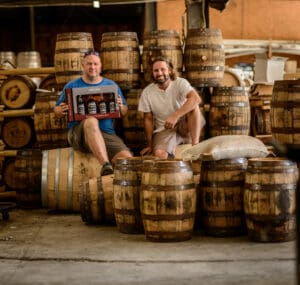
Cam Ford and Aaron Barns with Bourbon Barrels at Timber Creek
Scotch single malt is typically aged in used oak barrels—often ex-bourbon or ex-sherry casks. American Single Malt has no such restriction.
Many American producers use new American oak, used bourbon barrels, wine barrels, or specialty casks such as sherry, port, or rum. New oak brings intense flavors quickly, especially in warmer climates where maturation accelerates.
Scotch tends to emphasize subtlety and slow evolution. American Single Malt often leans toward richness and intensity. Neither is better. They are simply different dialects of the same language.
Why American Single Malt Matters
American Single Malt isn’t trying to replace Scotch. It isn’t trying to copy it. It’s doing something far more interesting.
It takes an old idea—the idea of one grain, one distillery, one whiskey—and lets American agriculture, climate, and creativity reinterpret it. That is how traditions stay alive. Not by freezing them in time, but by respecting their foundations while allowing them to evolve.
Final Thoughts
Single malt whiskey was never meant to be a luxury category. It was meant to be honest. Barley. Malt. One distillery. Time.
American Single Malt, at its best, returns to that honesty while adding a distinctly American accent. And just like wine, just like cigars, like all great agricultural expressions, the most interesting part isn’t what’s on the label.
It’s where it came from.
— Camden Ford